Monday, August 31, 2009

Id On Legs

Witches Abroad (Discworld, #12) Witches Abroad by Terry Pratchett


My rating: 3 of 5 stars
I may have liked this book better the second time. It has some wonderful moments, mostly involving Esme cleaning her ear. There's one brilliant quote from Magrat about good people creating justice and the bad inventing mercy.

Reading other people's reviews is interesting. Loved the French translation names for Esme, Nanny, and Magrat. Sometimes I think the most profound reviews are the ones that hit farthest from the mark. One person below couldn't get into the story at all - was unable to finish even the first chapter. Heh! At that time, Pratchett didn't use chapter divisions. But the beginning of this book has foreshadowing elements that don't make sense until you get over halfway through the story. This is probably what made it more enjoyable to me on the second read. Ah, that's Mrs. Gogol and Baron Samedi - excuse me - Saturday!

I learned an interesting fact, that Pratchett based this on the contrast between a Disney theme park and the real thing - as in New Orleans. Unfortunately, the reviewer seemed to think it sad that Pratchett thought life looked better through the bottom of a beer glass. I think the reviewer should get over this obsession with alcohol. Some people have a wonderful time at theme parks and when I was a kid, that could be fun. But then you grow up and want to appreciate the grittier things in life. With or without a bananananana dakyri. [Please note that only Nanny is a drinker. She's an Id on legs: food, drink, sex.]

View all my reviews >>

Tuesday, August 11, 2009

Bittersweet

Guards! Guards! (Discworld, #8) Guards! Guards! by Terry Pratchett


My rating: 4 of 5 stars
Read the Kindle edition this time, while I was away. The footnotes, while fiddly, are handled well. You click on the link and it sends you to the end of the book for the footnote, then press "back" to return to reading. Also have the condensed audiobook read by Tony Robinson. It's a shame his readings of Pratchett's works are condensed because I love his characterizations. There is a problem with some of the lines being too soft to hear if you're listening while driving on the highway in a cheap car and, well, you just miss so much in an abridged story. Someday I hope to acquire the unabridged Nigel Planer version. Planer also does a first-rate job, but the cost of the audiobooks he reads are prohibitive unless you subscribe to audible.com .

This, the first in the Watch series, is a story about bitterness and how we handle it. Captain Vimes funnels his into (or out of) a bottle (or more than just "a" bottle), the spinster Lady Ramkin devotes her life to the care and welfare of pets (of a sort), and the bitterness of the Elucidated Brethren becomes incarnate. Along with Captain Vimes, we meet Carrot Ironfoundersson, the Disc's tallest dwarf, who wouldn't know bitterness (or a metaphor) if it dared to slap him upside his head; Cheeky Nobby Nobbs (the Disc's shortest non-dwarf); and the man with the lucky arrow, Sergeant Colon. We observe the Patrician's peculiar methods of employee motivation and pest control. As usual, Pratchett turns a fairytale inside out. A king is found to save the land from the predations of a dragon, but although the core story doesn't work out the way expected, it does work out to the satisfaction of the reader.

Highly recommended. In fact, it's a million-to-one chance you'll love it. Stands to reason.

View all my reviews >>

Saturday, August 08, 2009

Polly Wanna Wossname

Eric (Discworld, #9) Eric by Terry Pratchett


My rating: 2 of 5 stars
I'm not the Rincewind fan some might be. Even less if David Jason is playing him. I don't understand that at all (of course, I looked up the dvd on Amazon to check the name of the actor and discovered that "The Color of Magic" was finally on sale in a format I can use ... and bought it immediately. Soooo, so much for that opinion!) and think Nigel Planer would have been a more likely Rincewind. Anyway, I needed something light and refreshing after that Anthony Trollope oeuvre, and ordered this for the Kindle. It was about 1/10 the size and just what the "Wizzard" ordered.
Rincewind stories fall into the "It's just one thing after another" category that my friend's mother complains about. Of course, she applied it to Pixar's "Finding Nemo" but it does describe the Rincewind stories in general and this one in particular [Interesting Times is an exception:]. That doesn't mean it isn't pure delight. The Kindle version did not have the illustrations the original did, so I can't comment on that. Rincewind would lend himself to a comic book or graphic novel format, considering the episodic nature of his adventures.
In this story, Rincewind is accidentally conjured up by a teenage boy Faust wannabe. It's all an excuse to send up the Faust legend, pre-Colombian civilization, Trojan War mythos, physics (one of Pratchett's favorite targets), and the infernal office politics engine (which justly deserves anything thrown at it). They are all nicely skewered but I think the last two parts suffer from inadequate development.

View all my reviews >>

Plus ça change, plus c'est la même debâcle economique

The Way We Live Now (Wordsworth Classics) The Way We Live Now by Anthony Trollope


My rating: 2 of 5 stars
This long, shambling story is not without interest. There is romance, intrigue, politics, Ponzi schemes, American character assassination (oh, I love it when the Brits do that - it's so much fun to see ourselves as others see us), a social structure in upheaval, and a critique of literary criticism. But it is pretty darn long. I read the Kindle edition and didn't pay attention to how long it was or I might have been daunted. Still, I had a short vacation coming up, spending a few days in a hotel in the middle of nowhere without a car, and figured if anything would drive me to read this, that would do it.
After that Hardy hodgepodge (Desperate Remedies, see my so-called review of that at http://staff-developomendo.blogspot.com/... ), I was leery of Trollope, but actually found myself enjoying this book. The characters and situations were not as over-the-top as in the Hardy story. Heroines who want answers about their fiancés will openly defy their mothers and take a train alone for the first time to track down answers, and good on 'em, I say!
Overly honorable men actually wrestle with their lesser, uglier feelings for quite a while before conquering them.
Chinless things in clubs have varying degrees of degradation if not actual separate and believable personalities.
And small, furry creatures from Alpha-Centauri would be, if they appeared in this book, separate and believable small, furry creatures from Alpha-Centauri.
Whatever you do, don't read the Wikipedia plot summary of this, which seems to be from a different version of the novel than I read. Paul went to Mexico to check on the progress of the railroad? Not in my book. That was just an offer to get him out of the boardroom and in the end he didn't fall for it. Also, an "editor" of that article complained that too much of the plot summary was given over to details of the plot. Excuse me? It's a frickin' plot summary! The complaint should be, the details of the plot are, at times, inaccurate. And how do you condense 100 chapters to a few paragraphs?
Anyway, whether it's a spoiler or not, all works out for The Best and the Truly Noble, or at least, Likable characters get the happy ending they so richly deserve. If you're touchy about anti-Semitism, you might want to take a chill pill before reading, or at least hold out for "fat, old Jew" who shows the backward Christians what Dignity is.

View all my reviews >>

Friday, July 31, 2009

When the Child Becomes the Parent

Mothering Mother: A Daughter's Humorous and Heartbreaking Memoir Mothering Mother: A Daughter's Humorous and Heartbreaking Memoir by Carol D. O'Dell


My rating: 2 of 5 stars
Each experience with Alzheimer's (or other dementia) is individual and unique, but there are many connecting points for anyone who cares for the elderly. Both of my parents are now gone, but I had a little trouble relating to this book because my experience was so different. O'Dell's mother adopted her when she was a child. Her mother was a preacher who occasionally slapped her around. O'Dell was rebellious as a teen. When O'Dell's husband was transferred out of state and there was no one to care for her mother who already had Parkinson's, they took her along, building a MIL apartment on their new house. O'Dell had to do all the work of caring for her mother as she became more enfeebled. This is so far from what was my situation.
O'Dell's desire to be a good daughter at the expense of her own happiness and the comfort of her own husband and children makes my martyr-complex look subatomic. (I go around telling people how lucky I had it and I was lucky. I had a devoted husband who did all the work for me and my parents had enough money so that they could afford some in-home help until their medical conditions called for Medicare to take over for a brief period. Sure, I was miserable and had to resort to prescription happy pills because it's just so goddam sad to see your parents not recognize you anymore. But Mom's dementia lasted almost exactly one year and Dad was able to live on his own with minimal help until the last year.) One starts to wonder if she protests too much. Or perhaps she tried to make up for her rebellious phase.
The writing is not stellar, but this is a real person talking about real things that happened, not some manipulative poet trying to wring the last tear out of you. I recall one instance of "Block that metaphor!" as the New Yorker will have it. There is an extended period after her mother dies that I feel drags on. This is probably because the much-anticipated event (and I'm speaking from personal experience here, my dad was 101 when he died) is still a shock when it happens and you don't really get around to mourning until months later. Then the things that set you off are the oblique ones you didn't see coming and hadn't built up any defenses for. Still, you've gotcher Climax and then your Denouement and the latter is supposed to be either shorter than the one in this book or more piquant.

As a side-note, the jacket blurb said that O'Dell taught creative writing and was published in some Chicken Soup compilation about sisters. I know she has 3 daughters, but I thought that was a nice juxtaposition considering she grew up as an adopted "only child." Ha,ha, I said to myself, creative writing and only child writing about sisters. Ha. [As an even side-r note, I consider the perpetrators of the Chicken Soup books to be utterly depraved, devoid of any conscience or taste. Not the writers, who are only literary whores, but the pimps and shills that foist them on the public. Just my opinion! La la la!:]

View all my reviews >>
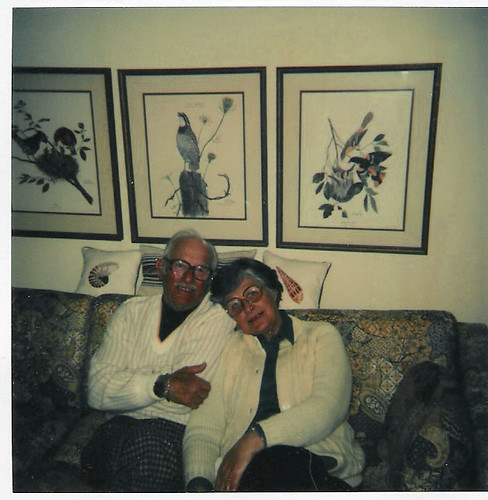
My parents while they still had all their marbles.

Wednesday, July 29, 2009

A Psychological Demi-Semi-Hemi-Thriller

Adam and Eve and Pinch Me Adam and Eve and Pinch Me by Ruth Rendell


My rating: 3 of 5 stars
This was a good read. Instead of figuring out whodunnit, we are taxed with whosolvzit. We have an omniscient view of the murder from soup to nuts. We see the situation forming, we see the murderer and the victim do their dance until they inevitably come together and the murderer spins away to get on with life. Then we wait while we wonder if the murderer will be discovered and we sort of hope not. Like most cozies, the victim seems to have deserved something, if not actual death. Rendell has manipulated our feelings and, in fact, one of the characters unwittingly discusses the the core at the center of the nub of the gist of this story: when is murder not murder? When is it not a sin? When does a murderer not deserve punishment? Is this even possible?
We also see how a murder investigation destroys the social fabric. Neighbors no longer trust each other. There's an amusing side-story of a closeted gay MP who tries to get himself a "beard" but the murder affects this as well. As in any good cozy, true tragedy is skirted, the gore is limited, and the world is righted in the end.

View all my reviews >>

Supersense Me!

SuperSense: Why We Believe in the Unbelievable SuperSense: Why We Believe in the Unbelievable by Bruce Hood


My rating: 5 of 5 stars
This was an eminently readable book about a fascinating topic. Hood posits that supernatural thinking (which covers a wide range of beliefs from religion to the feeling that someone is looking at you) is one of the bag of tricks in all human brains that came to us thanks to evolution. Is it possible to be free from it? Probably not, and this Supersense has its use in creating a sense of community in people, in sorting, in categorizing. Religion, it seems, is just a bonus. I read a review about this book on The Friendly Atheist's blog and snagged a Kindle version immediately. I might have to get hard copy of it for reference, because flipping through a Kindle isn't the cakewalk I'd like it to be.
Hood's prose is clear enough for anyone to understand (unusual in an academic), and while he does tend to repeat himself, I did not find this annoying, especially in picking it up and reading it in short bursts. It helps to be reminded of what he talked about in previous chapters. So much of this book is meaty information that I highlighted most of it. I recommend it for atheists and theists alike.
For me, it was an eyeopener to realize that the rabblerousers decrying gay marriage, etc. were using a time-honored method of improving community cohesiveness by appealing to a visceral sense of disgust. Sure, you can also build community on positive beliefs, but it's so much easier to manipulate people using disgust. This opens a path for rebuttal, a chance to show you're taking the high road. Okay, maybe that's just me.

View all my reviews >>

Friday, June 26, 2009

Inseparable and Equal

Friendship For Today Friendship For Today by Patricia C. McKissack


My review


rating: 3 of 5 stars
Must stop sitting at Children's Room desk crying over books! Went to pieces totally upon discovery that the part about the cat was true.

Rosemary's got a lot going on in her life. Her best friend has polio, now she has to start in an integrated school without him and be the only black child in the class, her parents' marriage is crumbling, and the cat is dying! Can she survive?

McKissick's portrayal of a 6th grader is pretty authentic. She wants to lash back when she's harassed. She thinks unkind thoughts. She makes friends with some white children, but she recognizes that they're just "a friendship for today." There are no miraculous transformations, which as an adult I appreciate. People might grudgingly accept each other, tolerate them, but no one really changes totally from the inside out. And no fairy descends to hit people with the wand and make everything perfect again. [Blows nose.]

These people struggled with integration about 5 years before I started school. I had to have "negro" explained to me when I went to kindergarten (and there weren't any in my class) and didn't actually meet any personally until the third grade, when I sat next to Wesley and in front of Valerie and Carmelita, effectively surrounding me. They were in my ballet class (I simply must find that photo!) but not my church. And they were never actually my friends ... just friends for today. I played with my nearest neighbors, who were white, out of convenience, although I can't say they were actually nice to me, so I guess it was just as well we didn't stay in that neighborhood long.

I have known people who survived some of the most painful integration experiences ... in Boston. Some are still sickened by the demonstration of unbridled hatred and for some, their education was derailed with lasting consequences.

I was lucky to have been brought up in a family where racism was only tacit. My mother grew up having Italians denigrated (they were smelly ... something about garlic and permanent underwear). My father's mother was straight from Germany so her prejudices had been limited to Jews and dumme Polacken. If my father modeled his jokes on Archie Bunker, he also included Germans in his ridicule, so at least he gave everyone the needle. My mother's prejudice was more subtle and I took my cue from her. I don't want to hear anyone say they are not prejudiced. We are all still a long way from that. The very least we can do is own up to it and try to do better.


View all my reviews.

All's Fair ...

Fair Weather Fair Weather by Richard Peck


My review


rating: 3 of 5 stars
Richard Peck keeps writing the book that I want to write. While this is not my favorite of his books, it still reminds me that I have a book I want to write - unfortunately, Peck wrote it first.

A farm family goes to the Chicago Columbian Exhibition of 1893 at the invitation of the aunt who lives in the city. One is being sent to get her away from a boyfriend her mother doesn't approve of. Their grandfather slips into the group so that he can see Buffalo Bill Cody's show, which was not permitted to be in the fair, so he set up his show right next to it.

Aunt Euterpe, the widow of a wealthy man, is bullied by her help and shunned by Chicago Society for being a young second wife. The actions of her nieces, nephew, and father (who actually calls her "Terpie" in public) only make her life worse ... at first.

The exhibition is taken in by the Fullers and no one dies (pity!). It's a nice introduction for children to the great fair and the innovations of the time period. There is only a slight amount of name dropping requiring suspension of disbelief and some interesting photos are included, disguised as postcards. Kids will also get a glimpse of farm life at the turn of the century ... and what my dad's early life was like. Grr!


View all my reviews.

Tuesday, June 23, 2009

"I'm Not Dead Yet!"

The Thin Woman The Thin Woman by Dorothy Cannell


My review


rating: 2 of 5 stars
Like most cozy reads, this one pulls up short from any graphic violence. The Thin Woman, belying the titular character in Hammett's book who actually was thin, has to lose over 60 lbs. in 6 months, among other things, to inherit "Uncle" Merlin's estate. Now, I don't mind telling you I get touchy about stories like this. I'd have an hourglass shape myself if I had a live-in Cordon Bleu chef (kinda like Oprah!) and the run-down house of an estate to put in order ...
Wait a minute ... Strike those last bits.
Anyway, if this book were actually about dieting, it would have been insufferable, but it's not. The mystery is also not in who killed whom, but in the past (or, in this case, the repast). Ellie and Ben must uncover the secret of Merlin's Court, having no idea where to start. And Ben must write a book both clean and fit for publishing. Falling down on any one of the three conditions will cost them the inheritance. There is enough cross-communication and auto-footshooting to satisfy readers fond of sexual tension, although that bit gets tiresome after a while and you start yelling at "Elizabeth" and "Mr. Darcy" to Just get it on for petessake! Despite increasingly goofy attempts, no one is killed, most people aren't even dead, and before Ellie and Ben can get too disgustingly lovey, they're pushed off a cliff. It's a light, entertaining read and I don't believe for 5 seconds that Ben would have liked her fat. So there.


View all my reviews.

Wednesday, June 17, 2009

How to Murder Your Parents - the Passive-Aggressive Way

The Willoughbys The Willoughbys by Lois Lowry


My review


rating: 3 of 5 stars
Oh, what hath Lemony Snicket wrought? True, authors are leaping on the bandwagon trying to capitalize on his popularity, but sometimes they come up with something good, some anti-treacle, a refreshing burst of acid for those tired of the usual children's fare.
This book, "nefariously written & ignominiously illustrated" by Lois Lowry is a very good story that disguises a vocabulary lesson. Like A Clockwork Orange the glossary is at the end and isn't discovered until too late when the reader has had to winkle out the meanings from context (at least that's what happened to me 30 years ago - I was quite annoyed to finish the book and then find the glossary after struggling through the first 5 pages). This makes it different from the Lemony Snicket books which define the more colorful words within the story.
The narrative runs counter to the usual derivative glurge written for children, but happily lists the classic originals at the end for further reading and comparison: The Adventures of Huckleberry Finn, Anne of Green Gables, The Bobbsey Twins and Baby May, A Christmas Carol, Heidi, James and the Giant Peach, Jane Eyre, Little Women, Mary Poppins, Pollyanna, Ragged Dick, The Secret Garden and Toby Tyler.
In this book, parents and children conspire to get rid of each other. The Willoughby kids actually want to be orphaned. They hope their parents will be eaten by crocodiles - and in chunks, because we know what happens when crocodiles don't chew their food. They rescue a baby left on the doorstep by dropping it at the door of a reclusive millionaire, which leaves her much better off than if she'd remained with the Willoughby's egocentric and hostile parents. The impossible happens, thanks to the Odious Nanny and Lowry's pen, and the deserving live happily ever after.


View all my reviews.

Sunday, June 14, 2009

All Tied Up

The Trouble With Physics: The Rise of String Theory, the Fall of a Science, and What Comes Next The Trouble With Physics: The Rise of String Theory, the Fall of a Science, and What Comes Next by Lee Smolin


My review


rating: 3 of 5 stars
OMG! Cosmological constants MIGHT NOT BE CONSTANT AFTER ALL!


Okay, this took me over a year to read and it was in, appearances to the contrary, English. I got stuck on the string theory part and more or less kept the book next to the bed for its soporific effects. Eventually the string theory went away and Smolin moved on to his loops (no better, is it?) and finally to his point, which is not that string theory is wrong (unlike that other book I bought at the same time, Not Even Wrong: The Failure of String Theory and the Search for Unity in Physical Law by Peter Woit - in case you're marveling at my intellect, I bought both of these for my husband), but that its proponents have a stranglehold on professional advancement to the point where if you don't work on string theory, you are lucky to be working at all.

This is not confined, Smolin says, to physics or science in general, but is endemic to academia. Important research is not being done if it doesn't reflect the status quo in the field. Applicants are not hired. Young academics are not advanced. Colleagues are sneered at. And when freedom is stifled in this way, good science is no longer done and no advancement is made. He points out that nothing new has come down the pike since the first exciting string "revelations."

Smolin makes a very good case that academia should take some lessons from the business world when it come to evaluating applicants. Professors are not trained to do this, he certainly wasn't, and ungodly amounts of his time are spent in evaluating applicants and preparing letters of recommendation for applicants.

Well, at least I could understand that part, having listened to a friend whose time is taken up with applicants for teaching positions and administrative positions in higher education.

This book is not meant as an indictment against string theory, and I think the title makes it plain. It's about how physics got stuck in a stalemate and why.


View all my reviews.

The Architect and the Archvillain

The Devil in the White City: Murder, Magic, and Madness at the Fair that Changed America The Devil in the White City: Murder, Magic, and Madness at the Fair that Changed America by Erik Larson


My review


rating: 3 of 5 stars
This was a Kindle version - found one typo.

Larson has used the Simon Winchester trick of starting with the very end of the story and then suddenly starting over. Okay, maybe other people use that, I just associate it with Winchester. Larson chooses to tell two stories, one of the creation of the Columbian Exhibition in Chicago and the serial-killer-next-door (inevitably bringing to mind The Professor and the Madman). Both narratives, I suppose, could be called stories of obsession. The building of the White City is tacitly compared with the building of the serial killer's dreamhouse-of-death, also making the comparison between Burnham and Holmes.

Both stories are engrossing and I've rated this pretty highly considering how much I complained about it. Holmes's story reads more like fiction. I have, consequently, more notes on the notes themselves than for the narrative. How can we know what Holmes was thinking? And if he wrote a memoir or confession (which of course he did), how can we trust the word of a psychopath? How can we know the details of how one of his victims died and his reaction? I take issue with this. Oh, it's evocative and thrilling and all, but can it be called non-fiction?

In the notes, Larson gives his excuses, which I still find thin. He makes speculations based on other people's speculations or "improves" on other people's speculations. I would also complain about the ghoulishness of writing about this, but I can't because I read Caleb Carr ... and then scoff that characters like that don't exist in real life. Guess I can't do that anymore.

To round things out on this topic, I'm going to re-read the fictional materials: The White City by Alec Michod as well as Fair Weather by Richard Peck (just to get the taste out of my mouth).


View all my reviews.

Saturday, June 13, 2009

And Some People Are Just Too Noble

The Guernsey Literary and Potato Peel Pie Society The Guernsey Literary and Potato Peel Pie Society by Mary Ann Shaffer


My review


rating: 2 of 5 stars
This was read in the Kindle edition.

I was totally unaware of the German occupation of the Channel Islands during WWII, so this served as a small and very interesting history lesson. Other than that, the story was not very original (most aren't) but it was told in an original and entertaining way. The romance part of the story is as predictable as Elizabeth and Mr. Darcy (and, come to think of it, I can make a case for parallels), you just wonder when they're going to get around to it.

Bits of it went beyond credulity - how can you paint a portrait of someone to make it look like an ancestor in such a short period of time? Have you any idea how long it takes oils to dry?! And then to age it? Anything inside a month would smell like new paint. And don't you love it how coincidence operates; that a couple might be on the point of a kiss and Exactly The Wrong Person shows up at that critical moment?

I know some people don't care for the epistolary style, but I enjoy it and I thought that was well done. It also enabled the story to be told in something other than chronological order and to kill off a main character in the middle of the book yet have that character remain a force throughout the rest of the book. You have to admit that that is a clever piece of work. So maybe I should give this two and a half stars.


View all my reviews.

Tuesday, June 09, 2009

Fortunately, His Writing Got Better ... I Think

Desperate Remedies Desperate Remedies by Thomas Hardy


My review


rating: 2 of 5 stars
Whatta potboiler this was! And as lame his use of mystery conventions (I was fairly groaning at the creakiness of it all) was, the heavy-handed manipulations had my heart rate up and drove me on to the end of it.

As for the characters, the main ones weren't very round or realistic (the young Cytherea was as wet a crustacean that ever got herself stuck in a pot and transferred to boiling water), but that was probably indicative of the time it was written. The heroine, assigned to do some research to help her case threw up her hands after one session of looking through newspapers and went palpitatin' to a chair, leaving her brother and lover to do all the legwork.

Who really believes that you can actually catch your death of cold out at night following a miscreant or that you can take to your bed, have what sounds like a stroke at bad news, be told you will recover, but because you've had them before know for certain that you won't?! What sense does that make?!

Read it for the laughable situations (keep that table between you and the Bad Man!) and dramatic hyperbole which have to be seen to believed, but there are some nice descriptions and amusing rude mechanicals. Oh, and a punchline at the end!


View all my reviews.

Friday, May 29, 2009

Go to Bed, Mrs. Merz!

This is Just to Say: Poems of Apology and Forgiveness This is Just to Say: Poems of Apology and Forgiveness by Joyce Sidman


My review


rating: 4 of 5 stars
I'm using this for a poetry/poultry workshop for kids this summer. This book is sooo good. This is a book of apology poems as written by 6th graders based on the William Carlos Williams poem of the same title. I mean, kids know all about apologies, right? They're made to apologize all the time whether they mean it or not.

The poems are funny, touching, and then are followed up by responses by the putative recipients of the apologies.

(Like this one:

Roses are red

Violets are blue

I'm still really

pissed off at you.
)


I have to admit that I was a sopping, snotty mess by the end of a 48 page book. Things are eaten, pets are put to sleep (boo hoo hoo hooooo!), parents walk out, hamsters bite the hand that feeds them - and there's a little morsel of brilliance in each one of these. But wait, there's more! One last joke in the name of the teacher ... Mrs. Merz. Fans of Vivian Vance salute you!


View all my reviews.

Wednesday, May 27, 2009

If You Have Lemons ...

The Lemonade War The Lemonade War by Jacqueline Davies


My review


rating: 3 of 5 stars
Evan can't do math, his younger sister (the math wiz) can't do emotions. Evan's angry because Jessie will be in his fourth grade class and will probably show him up. Instead of them doing a lemonade stand together, they set up competing stands. The capitalism is sandwiched between bouts of drama and junior angst. The children learn valuable family dynamics lessons at the end, except for Scott, who really needs to be in Juvenile Detention.
There's more story to this one than in Gary Paulsen's Lawn Boy. and it's slightly less of a fairy tale. Yes, forgiveness is achieved (what, between siblings? you must be kidding!), but it isn't all totally working out. Evan learns hard lessons about permits and sanitation. Lawn Boy only runs up against a Hostile Takeover, which is handled when he fortunately acquired a prize fighter. I like this book better because it was more realistic, keeping in mind that it is a kid's book.


View all my reviews.

Tuesday, May 26, 2009

The Color of Lawns

Lawn Boy Lawn Boy by Gary Paulsen


My review


rating: 2 of 5 stars
If only it were this easy. A 12 year old boy's scatty grandmother gives him an old riding lawnmower and he ends up with 15 employees, a broker, and an Enforcer (in the form of a prize-fighter he sponsors). I hope any kid who reads this also has been aware of the current state of the financial markets.
This is a short, light read about being a capitalist.


View all my reviews.

Wednesday, May 20, 2009

Stop the Handwringing Already! Wherein I Show That I Am Smarter Than Jane Austen

Pride and Prejudice Pride and Prejudice by Jane Austen


My review


rating: 2 of 5 stars
This was a Kindle read.
It was only the zombies that got me to pick this up (that is, the absence of them in this version). I wanted to see what the original material was. At first it was interesting to read and compare, but I think I lost interest as Elizabeth's respect for Mr. Darcy grew. By the end I was almost vomiting. Actual violence was a nice counterpoint to the barbed speech, sorta augmenting the idea of the the sentiment behind the speech. Elizabeth's rejection of Mr. Darcy's offer of marriage is the equivalent of throwing him against the fireplace. It made it easier for me to see the parallel in the original novel. Once Elizabeth realizes that Mr. Darcy is "worthy" of her affections and that she's really blown it and goes all icky about it, I lost interest. You've screwed that up? Move on, babe. Stop the hand-wringing already. Or at least don't make me read about it.

It all wraps up too tidily in the end as well. Her slutty sister did not merely make a mistake out of love, but she's a real piece of work who will never learn her lesson and will feel entitled to mooch off her relations forever. Someone needs to experience some Tough Love. Not the "put her out in the snow to fend on her own" sort, but the "show me you can manage the money you've got before I throw any more down the drain" kind.


View all my reviews.

No. 1 Series

The No. 1 Ladies' Detective Agency (No. 1 Ladies' Detective Agency, Book 1) The No. 1 Ladies' Detective Agency by Alexander McCall Smith


My review


rating: 4 of 5 stars
A re-read. This was originally published almost 20 years ago, so I have an excuse for having forgotten all the cases. I was utterly surprised by all the solutions. Love the little homages to Agatha Christie (Mma Christie - hahaha!), which must be where Mma Ramotswe got her idea to become a detective to begin with. McCall Smith writes with tenderness as well as humor and with great love for Africa, which he tries to project on Mma Ramotswe.

I can really appreciate the way the author slows us down to the African pace of life, to a slow and respectful speech. I really worried when I heard they were making a television series out of it, but a co-worker showed me some of the footage on the internet and tears rose in my eyes as I realized that they have probably done a really good job of it.


View all my reviews.