
 Posts
Posts




Showing posts with label poetry. Show all posts
Showing posts with label poetry. Show all posts
Monday, July 19, 2010
Langston Hughes
Oh, what pleasure! Simple and comprehensible! Moving because there is something deeply emotional to say. Six line verse blues poems. Music from the heart's blood. Thank you, thank you, Langston Hughes. Where do I start? I loved all of them. Some are funny (Morning After) and some are brutal (Song for a Dark Girl), but they're good and they're plain-spoken and meaningful.

Thursday, July 08, 2010
Hart Crane
I chose the Rip Van Winkle section from The Bridge for no real good reason. It's sad when a poet has to write copious notes about his own work to make it understandable. I found Walt Whitman's description of America much easier to follow. Rip Van Winkle carries happy childhood memories for me, so I risked having it ruined. But the mention of hurrying off to school with Pizarro and Cortes reminded me of my sister's favorite school poem: "Where we walk to school each day/Indian children used to play." And we are off on a time travel into Crane's past where lilacs provide a switch for his father to whip him and he recalls a fleeting smile from his mother that was never shared with him. Yikes! The Catskill daisy chain in May that is now Broadway was nice. Bits of this make you think Crane has potential, but wading through the whole of The Bridge is just too much of it.
Note of shameless self-promotion: My husband's last cd, Back In the Day, used Rip van Winkle as a theme. Buy it here!
Note of shameless self-promotion: My husband's last cd, Back In the Day, used Rip van Winkle as a theme. Buy it here!
Monday, June 28, 2010
T. S. Eliot
Oh great, the footnotes for this contain more material than the verses! Sheesh, and I thought Moore was annoying. Needs more cats. The Waste Land seems a pastiche of ... of ... well, I was going to say of other poems, but it seems to be a hodge-podge of imagery, memories, conversations, etc. that cry out for the sort of "close reading" that they now claim turns young people off from the enjoyment of literature entirely. It put me in mind of the aftermath of the Great War. That might not have been his intention (although I gather death was the inspiration), but that's what pops up in my little mind (probably the reference to the arch-duke and the expectation of the man returning from the army - Poor Albert!).
Marianne Moore
Gosh, how I wish we were back to Walt Whitman. What the introduction of the editor calls "wide-ranging diction" I call academic esoterica - I was particularly annoyed by the reference to "Bach's Solfegietto," although I liked the sound of the poem. The meter of "To a Prize Bird" was nice as well. I think I like the sounds of her poetry better than the imagery. I was all prepared to really like "A Jelly-fish" and in the end I was disappointed it didn't sting the author's arm ... good and hard.
I marked a few as being of relative interest for content. "The Past Is the Present" was marked for the description of unrhymed Biblical verse, which I will try to keep in mind as I traverse the Old Testament. "Hebrew poetry," I quote her quoting someone else, "is prose with a sort of heightened consciousness." I try to be aware of the aspects of verse in a foreign language that have been translated and may have lost their original beauty in the interests of accuracy. Translation is a tightrope walk.
I marked a few as being of relative interest for content. "The Past Is the Present" was marked for the description of unrhymed Biblical verse, which I will try to keep in mind as I traverse the Old Testament. "Hebrew poetry," I quote her quoting someone else, "is prose with a sort of heightened consciousness." I try to be aware of the aspects of verse in a foreign language that have been translated and may have lost their original beauty in the interests of accuracy. Translation is a tightrope walk.
Monday, June 21, 2010
Before I Get On To
... Marianne Moore, I'd like to quote some Billy Collins. Can't help it. I just enjoy his stuff so much:
Introduction to Poetry
by Billy Collins
I ask them to take a poem
and hold it up to the light
like a color slide
or press an ear against its hive.
I say drop a mouse into a poem
and watch him probe his way out,
or walk inside the poem's room
and feel the walls for a light switch.
I want them to water-ski
across the surface of a poem
waving at the author's name on the shore.
But all they want to do
is tie the poem to a chair with rope
and torture a confession out of it.
They begin by beating it with a hose
to find out what it really means.
This reminds me of when I was teaching Spanish and the beginning students were still stumbling through the idea of conjugation (of which there is precious little in English). "Just keep stumbling around in the dark room," I told them, "soon your eyes will be accustomed to the dark and you will see a crack of light around the door. Grope around and find the handle! Then you can open that door and step out into the light and it will become clear to you!" And they laughed at me.
One day, one girl said, "Oh, Profesora! I think I see the light! I think I see the light!" and started getting all excited. Or maybe she was just kidding.
Introduction to Poetry
by Billy Collins
I ask them to take a poem
and hold it up to the light
like a color slide
or press an ear against its hive.
I say drop a mouse into a poem
and watch him probe his way out,
or walk inside the poem's room
and feel the walls for a light switch.
I want them to water-ski
across the surface of a poem
waving at the author's name on the shore.
But all they want to do
is tie the poem to a chair with rope
and torture a confession out of it.
They begin by beating it with a hose
to find out what it really means.
This reminds me of when I was teaching Spanish and the beginning students were still stumbling through the idea of conjugation (of which there is precious little in English). "Just keep stumbling around in the dark room," I told them, "soon your eyes will be accustomed to the dark and you will see a crack of light around the door. Grope around and find the handle! Then you can open that door and step out into the light and it will become clear to you!" And they laughed at me.
One day, one girl said, "Oh, Profesora! I think I see the light! I think I see the light!" and started getting all excited. Or maybe she was just kidding.
Wednesday, May 26, 2010
The World's Most Dangerous Job
If there is any way to judge the value of a poem, it's probably the reaction it provokes, by imagery or emotion. It would be easy to find a poem by Robert Frost that reinforces the idea of the idyllic life of a farmer. Even easier is finding a poem outlining the horrors of rural life. Small wonder he gave it up and moved to England.
I can't even read this again, it was so powerful. It's called "Out, Out -" [on page 247] of the Major Voices and Visions anthology] and I wasn't even able to finish it, but the imagery clung to my thoughts and disturbed me the rest of the day.
It makes no sense, however, to mention a poem affected you profoundly and then not talk about it because it's just too painful to think about, so I'll add some tiny bits I gleaned from other Frost poems.
Frost seems to like the phrase, "the long scythe whispering to the ground" - which he used twice, just in this book. I have to say, I like it too. It has a nice cadence that calls to mind the swinging action and sound of the scythe (my dad used used one and the scythe does make this shushhhhh-shushhhhhing when it swings through the grass, very much like a whisper - a nice change from the gas-powered machinery prevalent today).
Another phrase was final line from "The Wood Pile," "the slow smokeless burning of decay" - which I also found evocative. It called to mind piles of wood chips that "cook" even in winter and give off steam. Something that I like about Frost is that he often has a story to tell, and I like a good story. In the case of "The Wood Pile" it's a conundrum. Why was this neatly stacked pile of wood left behind? Even better, it's a mystery story! Why does the farmer's wife just run off in The Hill Wife? Boredom? Is it related to a poem printed earlier (but not from that group) about the couple breaking up over the difference between how they handled the death of an infant? What was Frost's married life like? Inquiring minds want to know!
Stopping By Woods on a Snowy Evening - this photo always reminds me of that title:

Okay, that poem wasn't in this collection, but every time I see this photo I think of it. Anyway, that's all for Frost. I have lots to do and miles to go before I sleep.
I can't even read this again, it was so powerful. It's called "Out, Out -" [on page 247] of the Major Voices and Visions anthology] and I wasn't even able to finish it, but the imagery clung to my thoughts and disturbed me the rest of the day.
It makes no sense, however, to mention a poem affected you profoundly and then not talk about it because it's just too painful to think about, so I'll add some tiny bits I gleaned from other Frost poems.
Frost seems to like the phrase, "the long scythe whispering to the ground" - which he used twice, just in this book. I have to say, I like it too. It has a nice cadence that calls to mind the swinging action and sound of the scythe (my dad used used one and the scythe does make this shushhhhh-shushhhhhing when it swings through the grass, very much like a whisper - a nice change from the gas-powered machinery prevalent today).
Another phrase was final line from "The Wood Pile," "the slow smokeless burning of decay" - which I also found evocative. It called to mind piles of wood chips that "cook" even in winter and give off steam. Something that I like about Frost is that he often has a story to tell, and I like a good story. In the case of "The Wood Pile" it's a conundrum. Why was this neatly stacked pile of wood left behind? Even better, it's a mystery story! Why does the farmer's wife just run off in The Hill Wife? Boredom? Is it related to a poem printed earlier (but not from that group) about the couple breaking up over the difference between how they handled the death of an infant? What was Frost's married life like? Inquiring minds want to know!
Stopping By Woods on a Snowy Evening - this photo always reminds me of that title:
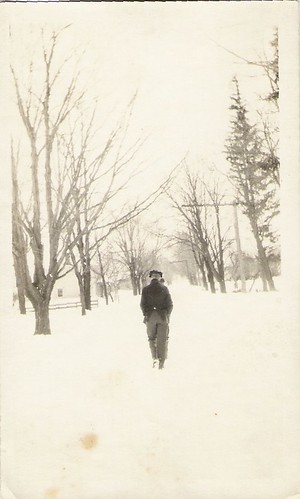
Okay, that poem wasn't in this collection, but every time I see this photo I think of it. Anyway, that's all for Frost. I have lots to do and miles to go before I sleep.
Monday, May 17, 2010
Song of ME ME ME!
Walt Whitman was slow going. As much as I understand that his use of the first person was to represent America, the "Song of Myself" still reeks of a towering ego (and he does refer to himself in it as "Walt" so I think the "It's Really About America" dodge doesn't hold water). You'd need a towering ego to think you are speaking for an entire country, even in reference to its diversity.
I also needed a dictionary to read this, as he seems to mix esoteric language with childishly made-up terms ("omnific" versus "foofoos"). His spelling is bad ("extatic") and he has a tendency to exaggerate, especially with numbers ("decillions" "sextillions" "quintillions"). So the words egocentric, hyperbolic, and epigrammatic spring to mind. "Song of Myself" is an onslaught, but I was still able to tease out little bits that I liked.
I guess the grass is itself a child .... the produced babe of
the vegetation.
Or I guess it is a uniform hieroglyphic,
And it means, Sprouting alike in broad zones and narrow zones,
Growing among black folks as among white,
Kanuck, Tuckahoe, Congressman, Cuff, I give them the
same, I receive them the same.
And now it seems to me the beautiful uncut hair of graves.
...
Whoever degrades another degrades me .... and whatever is
done or said returns at last to me.
And whatever I do or say I also return.
...
I hear the trained soprano .... she convulses me like the
climax of my love-grip;
The orchestra whirls me wider than Uranus flies,
It wrenches unnamable [sic] ardors from my breast,
It throbs me to gulps of the farthest down horror,
It sails me .... I dab with bare feet .... they are licked
by the indolent waves ...
[Hmmm, they're starting to pall on me now. I like the euphemism of the "love grip," which I find funny while it probably horrified his audience, but I totally agree about the trained soprano.]
...
And the running blackberry would adorn the parlors of
heaven...
[The blackberry is the rose that bears fruit. It lives on the fringes and brings sweetness to life, as well as a touch of bitter. There's no bitterness, though, that a touch of salt can't assuage.]
...
I think I could turn and live awhile with the animals ....
they are so placid and self-contained.
I stand and look at them sometimes half the day long,
They do not sweat and whine about their condition,
They do not lie awake in the dark and weep for their sins,
They do not make me sick discussing their duty to God,
Not one is dissatisfied .... not one is demented with the
mania of owning things,
Not one kneels to another nor to his kind that lived
thousands of years ago,
Not one is respectable or industrious over the whole earth.
Yeah, I must have dropped my tokens, too, Walt, speaking as one who is demented with the mania of owning things - and not even real things anymore. I don't have room for real things. Now I own virtual things and fritter hours of my time searching for more.
I would enjoy this more if it weren't so ponderous. I'll continue to read Whitman, but I'm relieved to be able to get on with Dickinson and sing all her poems to "The Yellow Rose of Texas."
I also needed a dictionary to read this, as he seems to mix esoteric language with childishly made-up terms ("omnific" versus "foofoos"). His spelling is bad ("extatic") and he has a tendency to exaggerate, especially with numbers ("decillions" "sextillions" "quintillions"). So the words egocentric, hyperbolic, and epigrammatic spring to mind. "Song of Myself" is an onslaught, but I was still able to tease out little bits that I liked.
I guess the grass is itself a child .... the produced babe of
the vegetation.
Or I guess it is a uniform hieroglyphic,
And it means, Sprouting alike in broad zones and narrow zones,
Growing among black folks as among white,
Kanuck, Tuckahoe, Congressman, Cuff, I give them the
same, I receive them the same.
And now it seems to me the beautiful uncut hair of graves.
...
Whoever degrades another degrades me .... and whatever is
done or said returns at last to me.
And whatever I do or say I also return.
...
I hear the trained soprano .... she convulses me like the
climax of my love-grip;
The orchestra whirls me wider than Uranus flies,
It wrenches unnamable [sic] ardors from my breast,
It throbs me to gulps of the farthest down horror,
It sails me .... I dab with bare feet .... they are licked
by the indolent waves ...
[Hmmm, they're starting to pall on me now. I like the euphemism of the "love grip," which I find funny while it probably horrified his audience, but I totally agree about the trained soprano.]
...
And the running blackberry would adorn the parlors of
heaven...
[The blackberry is the rose that bears fruit. It lives on the fringes and brings sweetness to life, as well as a touch of bitter. There's no bitterness, though, that a touch of salt can't assuage.]
...
I think I could turn and live awhile with the animals ....
they are so placid and self-contained.
I stand and look at them sometimes half the day long,
They do not sweat and whine about their condition,
They do not lie awake in the dark and weep for their sins,
They do not make me sick discussing their duty to God,
Not one is dissatisfied .... not one is demented with the
mania of owning things,
Not one kneels to another nor to his kind that lived
thousands of years ago,
Not one is respectable or industrious over the whole earth.
Yeah, I must have dropped my tokens, too, Walt, speaking as one who is demented with the mania of owning things - and not even real things anymore. I don't have room for real things. Now I own virtual things and fritter hours of my time searching for more.
I would enjoy this more if it weren't so ponderous. I'll continue to read Whitman, but I'm relieved to be able to get on with Dickinson and sing all her poems to "The Yellow Rose of Texas."
Friday, May 29, 2009
Go to Bed, Mrs. Merz!
 This is Just to Say: Poems of Apology and Forgiveness by Joyce Sidman
My review
rating: 4 of 5 stars
I'm using this for a poetry/poultry workshop for kids this summer. This book is sooo good. This is a book of apology poems as written by 6th graders based on the William Carlos Williams poem of the same title. I mean, kids know all about apologies, right? They're made to apologize all the time whether they mean it or not.
The poems are funny, touching, and then are followed up by responses by the putative recipients of the apologies.
(Like this one:
Roses are red
Violets are blue
I'm still really
pissed off at you.)
I have to admit that I was a sopping, snotty mess by the end of a 48 page book. Things are eaten, pets are put to sleep (boo hoo hoo hooooo!), parents walk out, hamsters bite the hand that feeds them - and there's a little morsel of brilliance in each one of these. But wait, there's more! One last joke in the name of the teacher ... Mrs. Merz. Fans of Vivian Vance salute you!
View all my reviews.
Wednesday, May 13, 2009
The Library Computer User's Pledge
Today I was going through some files at my desk looking for some "thingies" - you know, those - those things. You put them in binders and ... oh, nevermind. There was a file on computer miscellany and in it I found this "poem" I wrote as long as 10 years ago when we still had the Gates computers with internet in the Children's Room. Yeah. Think about it. We had to police fifth graders on the MTV site, adults from looking at what was literally a photo of a sucking chest wound (in the children's room! And looking at me completely mystified when I said, "Think of where you are!"), and kids endlessly clicking the print button. That was what really got to me, the endless clicking.
The Library Computer User's Pledge
I do promise
On my honor
That I will not
Be a speed mouse clicker.
I will point
And click one time.
Then I will wait
For the computer
To do its thing.
Only then
Will I click again.
Double-clicking
Is only for icons.
And I know enough
About computers
To know what an icon is.
I know so much,
In fact,
That I will never
Bother Miss Marf
Or Miss Nicole
Or Miss Abby
by saying:
"This won't work!"
I promise.
Here are some notes I made on children using computers from Jane M. Healy's Failure to Connect:
The learning gained (on the computer) will never replace that gained by caring for a pet or playing outdoors. (Warren Buckleitner, p 51)
Simple parent-child activities such as hobbies, games, and reading together have a solid research track record for improving academic skills. Using computers for these activities is both more expensive and less effective.
The key to positive use of any medium is the quality of the adult-child interaction. (p 73)
A youngster who spends a lot of early learning time on a computer is being programmed to prefer that type of presentation to reading a book, engaging in a discussion, or hearing a lecture about the same topic.(p 143)
Starting children on computers too early is far worse than starting them too late.
Don't let screen time substitute for lap time and don't expect books on CD-ROM to substitute for interactive reading with loving adults. (p 239)
And .. children below age 7 should not have unsupervised computer time. (p 250, italics mine, but could prolly use some boldface as well)
I might make a sign out of that last one.
All that said, I would like to add that a kid also needs time to be a kid without the adult interaction. It's up to y'all to balance that on your own. Me, I'd give 'em more play alone time as they age. They'll probably tell you when they want you to start butting out.
The Library Computer User's Pledge
I do promise
On my honor
That I will not
Be a speed mouse clicker.
I will point
And click one time.
Then I will wait
For the computer
To do its thing.
Only then
Will I click again.
Double-clicking
Is only for icons.
And I know enough
About computers
To know what an icon is.
I know so much,
In fact,
That I will never
Bother Miss Marf
Or Miss Nicole
Or Miss Abby
by saying:
"This won't work!"
I promise.
Here are some notes I made on children using computers from Jane M. Healy's Failure to Connect:
The learning gained (on the computer) will never replace that gained by caring for a pet or playing outdoors. (Warren Buckleitner, p 51)
Simple parent-child activities such as hobbies, games, and reading together have a solid research track record for improving academic skills. Using computers for these activities is both more expensive and less effective.
The key to positive use of any medium is the quality of the adult-child interaction. (p 73)
A youngster who spends a lot of early learning time on a computer is being programmed to prefer that type of presentation to reading a book, engaging in a discussion, or hearing a lecture about the same topic.(p 143)
Starting children on computers too early is far worse than starting them too late.
Don't let screen time substitute for lap time and don't expect books on CD-ROM to substitute for interactive reading with loving adults. (p 239)
And .. children below age 7 should not have unsupervised computer time. (p 250, italics mine, but could prolly use some boldface as well)
I might make a sign out of that last one.
All that said, I would like to add that a kid also needs time to be a kid without the adult interaction. It's up to y'all to balance that on your own. Me, I'd give 'em more play alone time as they age. They'll probably tell you when they want you to start butting out.
Sunday, April 29, 2007
Poetry Readings in SecondLife

Poetry readings at the Blue Angel Cafe, a supportive group for those who just have to get that poetry off their chests and spit.
Subscribe to:
Posts (Atom)