
 Posts
Posts




Monday, July 19, 2010
Langston Hughes
Oh, what pleasure! Simple and comprehensible! Moving because there is something deeply emotional to say. Six line verse blues poems. Music from the heart's blood. Thank you, thank you, Langston Hughes. Where do I start? I loved all of them. Some are funny (Morning After) and some are brutal (Song for a Dark Girl), but they're good and they're plain-spoken and meaningful.

Monday, July 12, 2010
iPads 'Stead of Libraries

This was an interesting idea ... close down the public libraries and give the library card holders a free iPad. The contributor says that all the books are then free. Perhaps that's not quite accurate, but even if they were, is it a good idea?
It was from the UK, but I thought about it for our library here in the US. We have about 30,000 users in our county (times $499 for an iPad) which would run us almost $15 million ... for a one-time purchase? That's more than the new library would cost, but perhaps Apple would give us a deal on the massive order. And I imagine a huge run on library cards if holders got a free iPad.
Now, what about on-going costs? The iPad runs on $15/mo. The public library ... oh, that's tougher. We used to get $2 per capita/yr, but now it's about half that. I don't have the figures in front of me, but my 1300 sq ft house contributed $13/yr to the library. It said so on the bill.
And the library comes with human beings you can talk to (if you haven't annoyed us too much) in real time about what book or information you really need. We don't run on batteries or the mains (but cookies help). And we have printers and a fax machine. Try to run that off your iPad.
Nice try, but until these devices and their support get cheaper, the good ole fashioned library is still a better deal.
Thursday, July 08, 2010
Hart Crane
I chose the Rip Van Winkle section from The Bridge for no real good reason. It's sad when a poet has to write copious notes about his own work to make it understandable. I found Walt Whitman's description of America much easier to follow. Rip Van Winkle carries happy childhood memories for me, so I risked having it ruined. But the mention of hurrying off to school with Pizarro and Cortes reminded me of my sister's favorite school poem: "Where we walk to school each day/Indian children used to play." And we are off on a time travel into Crane's past where lilacs provide a switch for his father to whip him and he recalls a fleeting smile from his mother that was never shared with him. Yikes! The Catskill daisy chain in May that is now Broadway was nice. Bits of this make you think Crane has potential, but wading through the whole of The Bridge is just too much of it.
Note of shameless self-promotion: My husband's last cd, Back In the Day, used Rip van Winkle as a theme. Buy it here!
Note of shameless self-promotion: My husband's last cd, Back In the Day, used Rip van Winkle as a theme. Buy it here!
Monday, June 28, 2010
T. S. Eliot
Oh great, the footnotes for this contain more material than the verses! Sheesh, and I thought Moore was annoying. Needs more cats. The Waste Land seems a pastiche of ... of ... well, I was going to say of other poems, but it seems to be a hodge-podge of imagery, memories, conversations, etc. that cry out for the sort of "close reading" that they now claim turns young people off from the enjoyment of literature entirely. It put me in mind of the aftermath of the Great War. That might not have been his intention (although I gather death was the inspiration), but that's what pops up in my little mind (probably the reference to the arch-duke and the expectation of the man returning from the army - Poor Albert!).
Marianne Moore
Gosh, how I wish we were back to Walt Whitman. What the introduction of the editor calls "wide-ranging diction" I call academic esoterica - I was particularly annoyed by the reference to "Bach's Solfegietto," although I liked the sound of the poem. The meter of "To a Prize Bird" was nice as well. I think I like the sounds of her poetry better than the imagery. I was all prepared to really like "A Jelly-fish" and in the end I was disappointed it didn't sting the author's arm ... good and hard.
I marked a few as being of relative interest for content. "The Past Is the Present" was marked for the description of unrhymed Biblical verse, which I will try to keep in mind as I traverse the Old Testament. "Hebrew poetry," I quote her quoting someone else, "is prose with a sort of heightened consciousness." I try to be aware of the aspects of verse in a foreign language that have been translated and may have lost their original beauty in the interests of accuracy. Translation is a tightrope walk.
I marked a few as being of relative interest for content. "The Past Is the Present" was marked for the description of unrhymed Biblical verse, which I will try to keep in mind as I traverse the Old Testament. "Hebrew poetry," I quote her quoting someone else, "is prose with a sort of heightened consciousness." I try to be aware of the aspects of verse in a foreign language that have been translated and may have lost their original beauty in the interests of accuracy. Translation is a tightrope walk.
Monday, June 21, 2010
Before I Get On To
... Marianne Moore, I'd like to quote some Billy Collins. Can't help it. I just enjoy his stuff so much:
Introduction to Poetry
by Billy Collins
I ask them to take a poem
and hold it up to the light
like a color slide
or press an ear against its hive.
I say drop a mouse into a poem
and watch him probe his way out,
or walk inside the poem's room
and feel the walls for a light switch.
I want them to water-ski
across the surface of a poem
waving at the author's name on the shore.
But all they want to do
is tie the poem to a chair with rope
and torture a confession out of it.
They begin by beating it with a hose
to find out what it really means.
This reminds me of when I was teaching Spanish and the beginning students were still stumbling through the idea of conjugation (of which there is precious little in English). "Just keep stumbling around in the dark room," I told them, "soon your eyes will be accustomed to the dark and you will see a crack of light around the door. Grope around and find the handle! Then you can open that door and step out into the light and it will become clear to you!" And they laughed at me.
One day, one girl said, "Oh, Profesora! I think I see the light! I think I see the light!" and started getting all excited. Or maybe she was just kidding.
Introduction to Poetry
by Billy Collins
I ask them to take a poem
and hold it up to the light
like a color slide
or press an ear against its hive.
I say drop a mouse into a poem
and watch him probe his way out,
or walk inside the poem's room
and feel the walls for a light switch.
I want them to water-ski
across the surface of a poem
waving at the author's name on the shore.
But all they want to do
is tie the poem to a chair with rope
and torture a confession out of it.
They begin by beating it with a hose
to find out what it really means.
This reminds me of when I was teaching Spanish and the beginning students were still stumbling through the idea of conjugation (of which there is precious little in English). "Just keep stumbling around in the dark room," I told them, "soon your eyes will be accustomed to the dark and you will see a crack of light around the door. Grope around and find the handle! Then you can open that door and step out into the light and it will become clear to you!" And they laughed at me.
One day, one girl said, "Oh, Profesora! I think I see the light! I think I see the light!" and started getting all excited. Or maybe she was just kidding.
Wednesday, May 26, 2010
The World's Most Dangerous Job
If there is any way to judge the value of a poem, it's probably the reaction it provokes, by imagery or emotion. It would be easy to find a poem by Robert Frost that reinforces the idea of the idyllic life of a farmer. Even easier is finding a poem outlining the horrors of rural life. Small wonder he gave it up and moved to England.
I can't even read this again, it was so powerful. It's called "Out, Out -" [on page 247] of the Major Voices and Visions anthology] and I wasn't even able to finish it, but the imagery clung to my thoughts and disturbed me the rest of the day.
It makes no sense, however, to mention a poem affected you profoundly and then not talk about it because it's just too painful to think about, so I'll add some tiny bits I gleaned from other Frost poems.
Frost seems to like the phrase, "the long scythe whispering to the ground" - which he used twice, just in this book. I have to say, I like it too. It has a nice cadence that calls to mind the swinging action and sound of the scythe (my dad used used one and the scythe does make this shushhhhh-shushhhhhing when it swings through the grass, very much like a whisper - a nice change from the gas-powered machinery prevalent today).
Another phrase was final line from "The Wood Pile," "the slow smokeless burning of decay" - which I also found evocative. It called to mind piles of wood chips that "cook" even in winter and give off steam. Something that I like about Frost is that he often has a story to tell, and I like a good story. In the case of "The Wood Pile" it's a conundrum. Why was this neatly stacked pile of wood left behind? Even better, it's a mystery story! Why does the farmer's wife just run off in The Hill Wife? Boredom? Is it related to a poem printed earlier (but not from that group) about the couple breaking up over the difference between how they handled the death of an infant? What was Frost's married life like? Inquiring minds want to know!
Stopping By Woods on a Snowy Evening - this photo always reminds me of that title:

Okay, that poem wasn't in this collection, but every time I see this photo I think of it. Anyway, that's all for Frost. I have lots to do and miles to go before I sleep.
I can't even read this again, it was so powerful. It's called "Out, Out -" [on page 247] of the Major Voices and Visions anthology] and I wasn't even able to finish it, but the imagery clung to my thoughts and disturbed me the rest of the day.
It makes no sense, however, to mention a poem affected you profoundly and then not talk about it because it's just too painful to think about, so I'll add some tiny bits I gleaned from other Frost poems.
Frost seems to like the phrase, "the long scythe whispering to the ground" - which he used twice, just in this book. I have to say, I like it too. It has a nice cadence that calls to mind the swinging action and sound of the scythe (my dad used used one and the scythe does make this shushhhhh-shushhhhhing when it swings through the grass, very much like a whisper - a nice change from the gas-powered machinery prevalent today).
Another phrase was final line from "The Wood Pile," "the slow smokeless burning of decay" - which I also found evocative. It called to mind piles of wood chips that "cook" even in winter and give off steam. Something that I like about Frost is that he often has a story to tell, and I like a good story. In the case of "The Wood Pile" it's a conundrum. Why was this neatly stacked pile of wood left behind? Even better, it's a mystery story! Why does the farmer's wife just run off in The Hill Wife? Boredom? Is it related to a poem printed earlier (but not from that group) about the couple breaking up over the difference between how they handled the death of an infant? What was Frost's married life like? Inquiring minds want to know!
Stopping By Woods on a Snowy Evening - this photo always reminds me of that title:
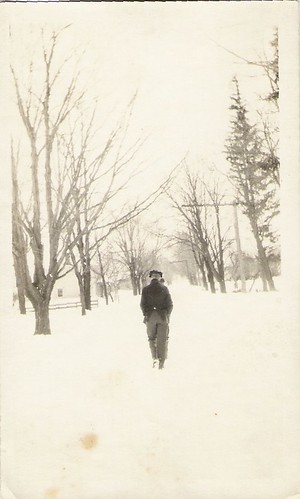
Okay, that poem wasn't in this collection, but every time I see this photo I think of it. Anyway, that's all for Frost. I have lots to do and miles to go before I sleep.
A Narrow Fellow
It's all I can do to not mention That Song in reference to Emily Dickinson's poetry. I read an article in Vanity Fair decades ago and shortly afterward got into an argument with a roommate who said all of Dickinson's poetry could not be sung to That Song. Then I proceeded to sing all the examples she dug out to That Song. Consequently, I have happy memories of Ms. Dickinson and go around singing "Because I would not stop for Death he kindly stopped for meeeeee!" But the same might be said about Edna St. Vincent Millay ... or José Martí, and about as accurately. In other words, not terribly.
Still, I have trouble relating to the content of Dickinson. I did see a lovely one that resonated with me immediately:
986
A narrow Fellow in the Grass
Occasionally rides -
You may have met Him - did you not
His notice sudden is -
The Grass divides as with a Comb-
A spotted shaft is seen -
And then it closes at your feet [Yipes!]
And opens further on -
He likes a Boggy Acre
A floor too cool for Corn -
Yet when a Boy, and Barefoot -
I more than once at Noon
Have passed, I though a Whip lash
Unbraiding in the Sun
When stooping to secure it
It wrinkled, and was gone -
Several of Nature's People
I know, and they know me -
I feel for them a transport
Of cordiality -
But never met this Fellow
Attended, or alone
Without a tighter breathing
And Zero at the Bone.
I think that concludes rather nicely - with that flash of iciness at the ribs (in my case, anyway) that suddenly coming upon such a "narrow Fellow" brings. The meter is irregular and takes some fudging to sing to That Song, stretching that final "Aaaaaand" to it's chilling climax. Great fun!
Still, I have trouble relating to the content of Dickinson. I did see a lovely one that resonated with me immediately:
986
A narrow Fellow in the Grass
Occasionally rides -
You may have met Him - did you not
His notice sudden is -
The Grass divides as with a Comb-
A spotted shaft is seen -
And then it closes at your feet [Yipes!]
And opens further on -
He likes a Boggy Acre
A floor too cool for Corn -
Yet when a Boy, and Barefoot -
I more than once at Noon
Have passed, I though a Whip lash
Unbraiding in the Sun
When stooping to secure it
It wrinkled, and was gone -
Several of Nature's People
I know, and they know me -
I feel for them a transport
Of cordiality -
But never met this Fellow
Attended, or alone
Without a tighter breathing
And Zero at the Bone.
I think that concludes rather nicely - with that flash of iciness at the ribs (in my case, anyway) that suddenly coming upon such a "narrow Fellow" brings. The meter is irregular and takes some fudging to sing to That Song, stretching that final "Aaaaaand" to it's chilling climax. Great fun!
Monday, May 17, 2010
Song of ME ME ME!
Walt Whitman was slow going. As much as I understand that his use of the first person was to represent America, the "Song of Myself" still reeks of a towering ego (and he does refer to himself in it as "Walt" so I think the "It's Really About America" dodge doesn't hold water). You'd need a towering ego to think you are speaking for an entire country, even in reference to its diversity.
I also needed a dictionary to read this, as he seems to mix esoteric language with childishly made-up terms ("omnific" versus "foofoos"). His spelling is bad ("extatic") and he has a tendency to exaggerate, especially with numbers ("decillions" "sextillions" "quintillions"). So the words egocentric, hyperbolic, and epigrammatic spring to mind. "Song of Myself" is an onslaught, but I was still able to tease out little bits that I liked.
I guess the grass is itself a child .... the produced babe of
the vegetation.
Or I guess it is a uniform hieroglyphic,
And it means, Sprouting alike in broad zones and narrow zones,
Growing among black folks as among white,
Kanuck, Tuckahoe, Congressman, Cuff, I give them the
same, I receive them the same.
And now it seems to me the beautiful uncut hair of graves.
...
Whoever degrades another degrades me .... and whatever is
done or said returns at last to me.
And whatever I do or say I also return.
...
I hear the trained soprano .... she convulses me like the
climax of my love-grip;
The orchestra whirls me wider than Uranus flies,
It wrenches unnamable [sic] ardors from my breast,
It throbs me to gulps of the farthest down horror,
It sails me .... I dab with bare feet .... they are licked
by the indolent waves ...
[Hmmm, they're starting to pall on me now. I like the euphemism of the "love grip," which I find funny while it probably horrified his audience, but I totally agree about the trained soprano.]
...
And the running blackberry would adorn the parlors of
heaven...
[The blackberry is the rose that bears fruit. It lives on the fringes and brings sweetness to life, as well as a touch of bitter. There's no bitterness, though, that a touch of salt can't assuage.]
...
I think I could turn and live awhile with the animals ....
they are so placid and self-contained.
I stand and look at them sometimes half the day long,
They do not sweat and whine about their condition,
They do not lie awake in the dark and weep for their sins,
They do not make me sick discussing their duty to God,
Not one is dissatisfied .... not one is demented with the
mania of owning things,
Not one kneels to another nor to his kind that lived
thousands of years ago,
Not one is respectable or industrious over the whole earth.
Yeah, I must have dropped my tokens, too, Walt, speaking as one who is demented with the mania of owning things - and not even real things anymore. I don't have room for real things. Now I own virtual things and fritter hours of my time searching for more.
I would enjoy this more if it weren't so ponderous. I'll continue to read Whitman, but I'm relieved to be able to get on with Dickinson and sing all her poems to "The Yellow Rose of Texas."
I also needed a dictionary to read this, as he seems to mix esoteric language with childishly made-up terms ("omnific" versus "foofoos"). His spelling is bad ("extatic") and he has a tendency to exaggerate, especially with numbers ("decillions" "sextillions" "quintillions"). So the words egocentric, hyperbolic, and epigrammatic spring to mind. "Song of Myself" is an onslaught, but I was still able to tease out little bits that I liked.
I guess the grass is itself a child .... the produced babe of
the vegetation.
Or I guess it is a uniform hieroglyphic,
And it means, Sprouting alike in broad zones and narrow zones,
Growing among black folks as among white,
Kanuck, Tuckahoe, Congressman, Cuff, I give them the
same, I receive them the same.
And now it seems to me the beautiful uncut hair of graves.
...
Whoever degrades another degrades me .... and whatever is
done or said returns at last to me.
And whatever I do or say I also return.
...
I hear the trained soprano .... she convulses me like the
climax of my love-grip;
The orchestra whirls me wider than Uranus flies,
It wrenches unnamable [sic] ardors from my breast,
It throbs me to gulps of the farthest down horror,
It sails me .... I dab with bare feet .... they are licked
by the indolent waves ...
[Hmmm, they're starting to pall on me now. I like the euphemism of the "love grip," which I find funny while it probably horrified his audience, but I totally agree about the trained soprano.]
...
And the running blackberry would adorn the parlors of
heaven...
[The blackberry is the rose that bears fruit. It lives on the fringes and brings sweetness to life, as well as a touch of bitter. There's no bitterness, though, that a touch of salt can't assuage.]
...
I think I could turn and live awhile with the animals ....
they are so placid and self-contained.
I stand and look at them sometimes half the day long,
They do not sweat and whine about their condition,
They do not lie awake in the dark and weep for their sins,
They do not make me sick discussing their duty to God,
Not one is dissatisfied .... not one is demented with the
mania of owning things,
Not one kneels to another nor to his kind that lived
thousands of years ago,
Not one is respectable or industrious over the whole earth.
Yeah, I must have dropped my tokens, too, Walt, speaking as one who is demented with the mania of owning things - and not even real things anymore. I don't have room for real things. Now I own virtual things and fritter hours of my time searching for more.
I would enjoy this more if it weren't so ponderous. I'll continue to read Whitman, but I'm relieved to be able to get on with Dickinson and sing all her poems to "The Yellow Rose of Texas."
Saturday, May 08, 2010
They Call Me "MISS Coraline"!

 Coraline by Neil Gaiman
My rating: 3 of 5 stars
Nicely drawn. Good story. I was just reading some graphic novels today and saw it hiding behind Beowulf Glad I saved it for last! Heh, I have some button eyes in Second Life that I think are cute (see above picture), but now they seem a bit more sinister. Good thing I read this in the daytime! I've been acquainted with Russell's artwork (in collaboration with Gaiman) in Neil Gaiman's Murder Mysteries, a very very very creepy book, especially the framework story! This story brought all that horror back to me.
Coraline is bored with her parents and her life, but when presented the opportunity of a life of endless amusement and devoted and doting parents, she chooses the chance to be bored on occasion. The mirror existence turns nightmarish and she embarks on a mini-quest to escape her "other mother," the Beldam. She will submit to having the button eyes sewn on if she can't locate her parents (in a rather obvious place, I thought) and the souls of three other children who were duped before her. All she has to help her are her courage, the cat, and a talisman: a rock with a hole in it. Oh, and those three kids.
And I wonder if that well is deep enough ...
View all my reviews >>
Monday, May 03, 2010
POST Hoc Ergo Propter Hoc
 The Sweetness at the Bottom of the Pie by Alan Bradley
My rating: 4 of 5 stars
This book has all the elements of the usual mystery story, but somehow seems to surprise. I didn't yell at this book once. The only quibble I have is that, unless someone in the de Luce family was an insane horticulturist that brought a sprig back as a specimen from a trip to North America, plants that produce urushiol don't grow in Britain. Okay, maybe it was a mango tree, but it sounded very much to me like it was poison ivy.
Aside from that, it was great fun! Flavia, the 11 year old chemist, is confronted with a mystery when she finds a man dying in the cucumber patch. [Note: I thought that type of poisoning was supposed to be instantaneous.] She must solve the mystery because her father has been detained, helping police with their inquiries and being fitted up. He, in turn, is covering for someone else.
Can Flavia exonerate her father before either the real murderer or one of her sadistic older sisters gets her? Read on!
View all my reviews >>
Thursday, April 29, 2010
What's the Point?
 The Tipping Point by Malcolm Gladwell
My rating: 2 of 5 stars
I am in the position of having two interests that need marketing, my job and my husband's business. When I started doing programming at the library, we couldn't do enough. Storytimes were increasing to satisfy demand. Now, there are times when no one shows up. There are a number of reasons for this, one of which is, unbelievably, that there are still people out there who don't know what the library does despite newspaper, radio, and posters. All this talk of viral marketing seems like the last hope - but none of it seems to work. And Gladwell's book seems to explain why.
There are just three factors to tip something over the edge: the influential few, stickiness, and context. There was some context we had no control over. The rules for transporting children changed and became much more stringent. Home Child Care people were no longer able to bring their charges to a storytime. We still had a few of the larger corporate facilities that could transport, but fewer came. If the smaller ones can't afford it or aren't able, you cut out a huge audience. And if the kids can't say they went to the library that day, the parents stop thinking about it. We are doing outreach to the bigger groups, but it isn't the same.
We finally have someone in our department who is a connector. This can help. I'm not sure what could be sticky about library programming.
This book started off being exciting, but I lost that interest as I went on (and it's not that long of a book). Eventually, I was only vaguely interested on how demonizing cigarettes and other drugs has absolutely, positively not worked and just glanced over the rest.
Thinking further about marketing needs here, while a new library will raise our profile, that's a factor that will lose its sheen after a while. [I'm still annoyed by the patron who said, "No offense, but this is the most depressing library I've ever been in." I've been in lots more depressing libraries than this. I thought our children's room was pretty colorful and had lots of interesting features!] If the general public is anything like me, they go home and stay there. It's just too exhausting to go out again. If their kids aren't lobbying to go to the library, very few will venture out of the cocoon. While we have an annual library card drive for the youngest kids in school, how many of those actually come in once they've received their card? We have anecdotal stories of parents being dragged in by a kid that's just gotten a card, but if all the kids who received library cards since I've been typing them up have come in, why are there any books on these shelves at all?
It's stickiness. We need to work on that.
View all my reviews >>
Saturday, April 17, 2010
Early Literacy Re-Training!
When I signed up for this, I was sure it included some Mother Goose On the Loose training, which I hadn't had, but was glad to have some of the Every Child Ready To Read re-training in any case. MGOTL was not in evidence, but a worthwhile day was spent on ECRTR. This is at least the third time that I have been trained in this and I think it's great stuff. It's nice to have it refreshed and because you have new people with you, you get more ideas on how to use it than just a presenter can provide.
The class was presented by Susan Bard who was very energetic. I'd have been more energetic myself if some of the songs and movement things we did weren't making me dizzy. I had dinged my forehead on the bathroom stall door (something another librarian also did shortly after I was settled down with my feet up and a bag of ice on my head) which served mostly to keep me awake all day.
ECRTR is designed to make it easy and palatable to share early literacy tips with parents and caregivers during storytimes. Bite-size, manageable pieces of information are coupled with modeling during the storytime so that parents are "indoctrinated" in best practices practically without realizing it. The resources are also available online (also in Spanish) for those who didn't have a throbbing forehead to keep them awake - but, honestly, these classes are so much fun you don't want to miss any of it.
Recommendations of great storytime picture books and audio abound. Those I particularly noted were:
Cha Cha Chimps by Judy Durango
Shark in the park by Nick Sharratt
Dinosaur Roar by Paul Strickland
Pío Peep by Alma Flor Ada and F. Isabel Campoy
Flower Garden by Eve Bunting
Bark George by Jules Feiffer
Audio
Diaper Gym
Whaddaya Think Of That by Laurie Berkner
Toddlers Sing Playtime (actually, recordings of toddlers singing creeps me out)
Babies have 100 billion little brain cells to work with when they are born. They develop connections (synapses) primarily through sensory experiences. They will make more of these connections with higher seratonin levels, which come about from pleasurable experiences. Connections are inhibited by cortisol, which is released under stress, such as neglect and abuse, but they can also be stressed by the unreasonable expectations of the parent, childcare provider, or even the crabby librarian with the big lump on her head. Little kids have short attention spans and are apt to try to get up and walk around. It doesn't mean they aren't still listening. We need to let parents/caregivers know at the start that a little wiggle is okay. If a child gets bored, he can be removed, but he can also come back if he's settled down.
Kids get all these sensory experiences and then the ones that aren't experienced over and over are eventually pruned, which helps organize the brain. Those paths revisited can be early literacy skills that the child will need to learn to read and read with ease later. Before you can read, you need to know the words; the more words the child hears, the more will be recognized when seen printed, so talking to the child is important. Before you can read, you need to recognize shapes, because letters come in shapes. Shape recognition is good for babies. Letter recognition can begin with toddlers. And all this needs to be fun, not drills with flashcards. You don't need to be able to read to provide these early literacy skills to your child. You don't need to speak English - because all that knowledge is commutative from one language to another: hearing separate sounds/phonemes, connecting sounds with the shapes of letters, how a book works, etc.
The parents are the first and best teachers. They spend the most time with the children and the children model their behavior based on the adults they see the most - for good or ill.
None of this synapse connecting can wait for school. These are skills a kid needs to know before she gets to school:
Print Motivation - enjoying books and reading
Phonological Awareness - hearing the distinct sounds in words and being able to play with them
Vocabulary - hearing the words so when they are seen in print, there is recognition
Narrative Skills - knowing stories have a beginning, middle, and end; following sequences; describing an activity
Print Awareness - recognizing print in the environment, being familiar with books
Letter Knowledge - recognizing one letter as distinct from another and knowing it can have more than one form (upper/lower cases, for instance).
Alphabet knowledge at entry into Kindergarten is a strong predictor of reading ability in 10th grade. Children from lower income groups have 25 hours of contact with picture book reading compared to over 1,200 hours for middle income children. 60% of kids are going to find learning to read difficult. As librarians we are in a position to make that process more fun by providing great materials and modeling best practices for the benefit of the caregivers. Encourage the parents to allow the children to pick out their own books and be sure to let them choose some non-fiction books as well as story picture books.
Now, that's all the general stuff. Let's get down to specifics that I needed reminding on!
Remember, only one early literacy skill per storytime! And just mention it briefly, paraphrased from the "What Can I Say" list in your own words, about three times during the storytime. That's all you have to do. It helps to write it out ahead and practice it.
Talking uses four parts of the brain and in a small child this can take some time because the neural pathways are still being built. Be sure to give 5 seconds response time to a young child. If there are older siblings, they might want to butt in, but let the young one finally get the answer out.
Use dialogic questions - you know, the ones that don't have yes or no answers. This isn't the best idea during a story if you have a group, but works well one on one. With a group you can ask that kind of question at the beginning or the end of the story, as in Bark, George - you can ask What happened, Why is George saying hello instead of barking, Where's the vet?!
Read to kids the books you like. Read books the kids like. Read books with movements. Be a Fierce Dinosaur! Be a meek dinosaur.
Never substitute an easy word. Use the "rare words" - and define them as you go along. If it's an object, point to a picture of it. If it's an action, act it out. Give a synonym: That's another word for _____. Let parents know, "You may have noticed there were some rare words in that story ..."
The early literacy skill of the week could be put on a handout that they take home after the storytime (the one, maybe, that you have the song lyrics and fingerplays on so that the caregivers can sing along) and/or that sits out for the general public all week. Remember to invite the caregivers to take part at the beginning of storytime so that the shyer children will feel secure in participating (and so they won't sit gossiping in the back, which is sometimes a problem in my storytimes).
Here's a nice way to start: hold up a picture of a clock and say, "Thank you for coming on time!" And remind them to turn their cellphones off. Do this each time to be consistent.
I have a little song I sing:
I went to the storytime [can substitute "puppet show"] with my mom
But she left her cellphone on.
The cellphone rang and she took the call.
Now we're not allowed back in at all!
Then I have the kids pretend to turn off their "cellphones" and put them away in their pockets. They actually enjoy doing this and there's usually an adult who goes "OH!" and scrambles for the cellphone. There is hardly anything more annoying than someone whose phone rings, she answers it, and says, "Oh, we're at storytime at the library!" and keeps talking.
There was a nice sheet on Challenges and Problem Solving, but there was nothing in there about the distraction of a child throwing up and then a clean-up committee coming in to take care of that. I decided that I didn't have anything more interesting than that prepared so we watched them until they were done and then went on with the storytime.
If anyone has a chance to attend one of these workshops, I highly recommend it. I even recommend going again and again.
The class was presented by Susan Bard who was very energetic. I'd have been more energetic myself if some of the songs and movement things we did weren't making me dizzy. I had dinged my forehead on the bathroom stall door (something another librarian also did shortly after I was settled down with my feet up and a bag of ice on my head) which served mostly to keep me awake all day.
ECRTR is designed to make it easy and palatable to share early literacy tips with parents and caregivers during storytimes. Bite-size, manageable pieces of information are coupled with modeling during the storytime so that parents are "indoctrinated" in best practices practically without realizing it. The resources are also available online (also in Spanish) for those who didn't have a throbbing forehead to keep them awake - but, honestly, these classes are so much fun you don't want to miss any of it.
Recommendations of great storytime picture books and audio abound. Those I particularly noted were:
Cha Cha Chimps by Judy Durango
Shark in the park by Nick Sharratt
Dinosaur Roar by Paul Strickland
Pío Peep by Alma Flor Ada and F. Isabel Campoy
Flower Garden by Eve Bunting
Bark George by Jules Feiffer
Audio
Diaper Gym
Whaddaya Think Of That by Laurie Berkner
Toddlers Sing Playtime (actually, recordings of toddlers singing creeps me out)
Babies have 100 billion little brain cells to work with when they are born. They develop connections (synapses) primarily through sensory experiences. They will make more of these connections with higher seratonin levels, which come about from pleasurable experiences. Connections are inhibited by cortisol, which is released under stress, such as neglect and abuse, but they can also be stressed by the unreasonable expectations of the parent, childcare provider, or even the crabby librarian with the big lump on her head. Little kids have short attention spans and are apt to try to get up and walk around. It doesn't mean they aren't still listening. We need to let parents/caregivers know at the start that a little wiggle is okay. If a child gets bored, he can be removed, but he can also come back if he's settled down.
Kids get all these sensory experiences and then the ones that aren't experienced over and over are eventually pruned, which helps organize the brain. Those paths revisited can be early literacy skills that the child will need to learn to read and read with ease later. Before you can read, you need to know the words; the more words the child hears, the more will be recognized when seen printed, so talking to the child is important. Before you can read, you need to recognize shapes, because letters come in shapes. Shape recognition is good for babies. Letter recognition can begin with toddlers. And all this needs to be fun, not drills with flashcards. You don't need to be able to read to provide these early literacy skills to your child. You don't need to speak English - because all that knowledge is commutative from one language to another: hearing separate sounds/phonemes, connecting sounds with the shapes of letters, how a book works, etc.
The parents are the first and best teachers. They spend the most time with the children and the children model their behavior based on the adults they see the most - for good or ill.
None of this synapse connecting can wait for school. These are skills a kid needs to know before she gets to school:
Print Motivation - enjoying books and reading
Phonological Awareness - hearing the distinct sounds in words and being able to play with them
Vocabulary - hearing the words so when they are seen in print, there is recognition
Narrative Skills - knowing stories have a beginning, middle, and end; following sequences; describing an activity
Print Awareness - recognizing print in the environment, being familiar with books
Letter Knowledge - recognizing one letter as distinct from another and knowing it can have more than one form (upper/lower cases, for instance).
Alphabet knowledge at entry into Kindergarten is a strong predictor of reading ability in 10th grade. Children from lower income groups have 25 hours of contact with picture book reading compared to over 1,200 hours for middle income children. 60% of kids are going to find learning to read difficult. As librarians we are in a position to make that process more fun by providing great materials and modeling best practices for the benefit of the caregivers. Encourage the parents to allow the children to pick out their own books and be sure to let them choose some non-fiction books as well as story picture books.
Now, that's all the general stuff. Let's get down to specifics that I needed reminding on!
Remember, only one early literacy skill per storytime! And just mention it briefly, paraphrased from the "What Can I Say" list in your own words, about three times during the storytime. That's all you have to do. It helps to write it out ahead and practice it.
Talking uses four parts of the brain and in a small child this can take some time because the neural pathways are still being built. Be sure to give 5 seconds response time to a young child. If there are older siblings, they might want to butt in, but let the young one finally get the answer out.
Use dialogic questions - you know, the ones that don't have yes or no answers. This isn't the best idea during a story if you have a group, but works well one on one. With a group you can ask that kind of question at the beginning or the end of the story, as in Bark, George - you can ask What happened, Why is George saying hello instead of barking, Where's the vet?!
Read to kids the books you like. Read books the kids like. Read books with movements. Be a Fierce Dinosaur! Be a meek dinosaur.
Never substitute an easy word. Use the "rare words" - and define them as you go along. If it's an object, point to a picture of it. If it's an action, act it out. Give a synonym: That's another word for _____. Let parents know, "You may have noticed there were some rare words in that story ..."
The early literacy skill of the week could be put on a handout that they take home after the storytime (the one, maybe, that you have the song lyrics and fingerplays on so that the caregivers can sing along) and/or that sits out for the general public all week. Remember to invite the caregivers to take part at the beginning of storytime so that the shyer children will feel secure in participating (and so they won't sit gossiping in the back, which is sometimes a problem in my storytimes).
Here's a nice way to start: hold up a picture of a clock and say, "Thank you for coming on time!" And remind them to turn their cellphones off. Do this each time to be consistent.
I have a little song I sing:
I went to the storytime [can substitute "puppet show"] with my mom
But she left her cellphone on.
The cellphone rang and she took the call.
Now we're not allowed back in at all!
Then I have the kids pretend to turn off their "cellphones" and put them away in their pockets. They actually enjoy doing this and there's usually an adult who goes "OH!" and scrambles for the cellphone. There is hardly anything more annoying than someone whose phone rings, she answers it, and says, "Oh, we're at storytime at the library!" and keeps talking.
There was a nice sheet on Challenges and Problem Solving, but there was nothing in there about the distraction of a child throwing up and then a clean-up committee coming in to take care of that. I decided that I didn't have anything more interesting than that prepared so we watched them until they were done and then went on with the storytime.
If anyone has a chance to attend one of these workshops, I highly recommend it. I even recommend going again and again.
Tuesday, April 13, 2010
Top 100 Children's Books
The Top 100 Children's Books list from the School Library Journal poll. I tried linking, but my HTML was not accepted.
I've bolded (hee, is that a real verb now?) the ones I have read. I've only read half of them! There may be a couple more that I missed. I may have read Pippi Longstocking as a child, but have forgotten. I thought I'd read all the Roald Dahl children's books, but the plot to Matilda escapes me. Some of these I'm interested in reading and some I have absolutely no interest in (like the Laura Ingalls Wilder stories). In any event, what I great job I have that I can sit around and read fun books with impunity! Wheeee! Take that, Wall Street!
I've bolded (hee, is that a real verb now?) the ones I have read. I've only read half of them! There may be a couple more that I missed. I may have read Pippi Longstocking as a child, but have forgotten. I thought I'd read all the Roald Dahl children's books, but the plot to Matilda escapes me. Some of these I'm interested in reading and some I have absolutely no interest in (like the Laura Ingalls Wilder stories). In any event, what I great job I have that I can sit around and read fun books with impunity! Wheeee! Take that, Wall Street!
100. The Egypt
99. The Indian in the Cupboard - Banks (1980)
98. Children of Green Knowe -Boston
97. The Miraculous Journey of Edward Tulane - DiCamillo (2006)
96. The Witches - Dahl (1983)
95. Pippi Longstocking - Lindgren (1950) may have read ... got the idea anyway.
94. Swallows and Amazons - Ransome (1930)
93. Caddie Woodlawn - Brink (1935) Planning on reading at some point.
92. Ella Enchanted - Levine (1997)
91. Sideways Stories fromWayside School
90. Sarah, Plain and Tall - MacLachlan (1985)89. Ramona and Her Father - Cleary (1977) I've read 2 or 3 Cleary books. They all slur together.
88. The High King - Alexander (1968) Read The Book of Three and Lost Interest.
87. The View from Saturday - Konigsburg (1996)
86. Harry Potter and the Chamber of Secrets - Rowling (1999)85. On the Banks of Plum Creek - Wilder (1937) Bleagh, no thanks.
84. The Little White Horse - Goudge (1946)
83. The Thief - Turner (1997)
82. The Book of Three - Alexander (1964) Ho hum. Don't need to read any more of them.
81. Where the Mountain Meets the Moon - Lin (2009)
80. The Graveyard Book - Gaiman (2008) Literally broke down and cried when I heard this won the Newbery. Not sure why. I hadn't even read it. Just happy for Gaiman, I guess.
79. All-of-a-Kind-Family -Taylor
78. Johnny Tremain - Forbes (1943) I keep looking at this thinking I should read it.
77. The City ofEmber
76. Out of the Dust -Hesse (1997) A novel in verse? I thought this was going to be ghastly, so I started 1/3 of the way in (the way I handle books I think I won't like - get the exposition out of the way. I can always go back and start over) and immediately realized I would have to ... go back and start over.
75. Love That Dog - Creech (2001) Hmm, may read.
74. The Borrowers - Norton (1953) Will put on To Read list.
73. My Side of the Mountain - George (1959)
72. My Father's Dragon - Gannett (1948) Grew up with these books.
71. The Bad Beginning - Snicket (1999) Read a few of these, that was enough.70. Betsy-Tacy - Lovelae (1940)
69. The Mysterious Benedict Society - Stewart ( 2007)
68. Walk Two Moons - Creech (1994)
67. Jeremy Thatcher, Dragon Hatcher - Coville (1991) Read some of his other books ... will think about it.
66. Henry Huggins - Cleary (1950)
65. Ballet Shoes - Stratfeild (1936)
64. A Long Way fromChicago
63.Gone-Away Lake
62. The Secret of the Old Clock -Keene
61. Stargirl - Spinelli (2000)
60. The True Confessions of Charlotte Doyle - Avi (1990)
59. Inkheart - Funke (2003) Mmnnnrrrr, I don't know. Read The Thief Lord and wasn't that impressed.
58. The Wolves ofWilloughby
57. Ramona Quimby, Age 8 - Cleary (1981)
56. Number the Stars - Lowry (1989) Can't read Holocaust stories - they give me nightmares.
55. The Great Gilly Hopkins -Paterson
54. The BFG - Dahl (1982)
53. Wind in the Willows - Grahame (1908)
52. The Invention of Hugo Cabret (2007) Very imaginative and able to spark more imagination.
51. The Saturdays - Enright (1941)
50. Island of the Blue Dolphins - O'Dell (1960)
49. Frindle - Clements (1996)
48. The Penderwicks - Birdsall (2005) Listened to the audiobook and nearly vomited through the whole thing.
47. Bud, Not Buddy - Curtis (1999) Nothing can hold a candle to TWGTB-1963. It was okay.
46. Where the Red Fern Grows - Rawls (1961)
45. The Golden Compass -Pullman
44. Tales of a Fourth Grade Nothing - Blume (1972) Might have read this.
43. Ramona thePest - Cleary (1968) Might have read this as well.
42. Little House on the Prairie - Wilder (1935) Forget. It.
41. The Witch of Blackbird Pond - Speare (1958)
40. The Wonderful Wizard of Oz - Baum (1900)39. When You Reach Me - Stead (2009)
38. HP and the Order of thePhoenix Taylor
36. Are You there, God? It's Me, Margaret - Blume (1970)
35. HP and the Goblet of Fire - Rowling (2000)
34. The Watson's Go toBirmingham
33. James and the Giant Peach - Dahl (1961) The first book a librarian ever recommended to me that I liked. In fact, I loved this book.
32. Mrs. Frisby and the Rats of NIMH - O'Brian (1971)31. Half Magic - Eager (1954)
30. Winnie-the-Pooh - Milne (1926)
29. The Dark Is Rising - Cooper (1973) I had to listen to the audio of this because reading it was too intense an experience!
28. A Little Princess - Burnett (1905) Read this every month for years and cried my little heart out. Prefer The Secret Garden now. Don't need any help crying. 27. Alice I and II - Carroll (1865/72)26. Hatchet - Paulsen (1989) Read Paulsen's accounts of his real life experiences and it made me terrified of moose attacks. Think I'll pass.
25. Little Women - Alcott (1868/9)
24. HP and the Deathly Hallows - Rowling (2007) Too long. Too much wandering around in the woods.
23. Little House in the Big Woods - Wilder (1932)
22. The Tale of Despereaux - DiCamillo (2003) Mnyeh.
21. The Lightening Thief - Riordan (2005) Update: Tried to read this. Gave up. And I was a big fan of Greek mythology. Oh well.
20. Tuck Everlasting - Babbitt (1975)
19. Charlie and the Chocolate Factory - Dahl (1964)18. Matilda - Dahl (1988) Thought I'd read all of these.
17. Maniac Magee - Spinelli (1990)
16. Harriet the Spy - Fitzhugh (1964) Not sure what the point of this book is.
15. Because of Winn-Dixie - DiCamillo (2000)
14. HP and the Prisoner of Azkaban - Rowling (1999) My favorite of these.
13. Bridge to Terabithia -Paterson
12. The Hobbit - Tolkien (1938)11. The Westing Game - Raskin (1978)
10. The Phantom Tollbooth - Juster (1961)9. Anne of Green Gables -Montgomery
8. TheSecret Garden
6. Holes - Sachar (1998) Excellent story. Movie didn't ruin it either (helps for the author to write the screenplay).
5. From the Mixed-Up Files of Mrs. Basil E. Frankweiler - Koningsburg (1967)
4. The Lion, the Witch, and the Wardrobe - Lewis (1950) Not much value as a story and a bit hit-you-over-the-head as allegory.
3. Harry Potter #1 - Rowling (1997)
2. A Wrinkle in Time - L'Engle (1962)
1.Charlotte
99. The Indian in the Cupboard - Banks (1980)
98. Children of Green Knowe -
97. The Miraculous Journey of Edward Tulane - DiCamillo (2006)
96. The Witches - Dahl (1983)
95. Pippi Longstocking - Lindgren (1950) may have read ... got the idea anyway.
94. Swallows and Amazons - Ransome (1930)
93. Caddie Woodlawn - Brink (1935) Planning on reading at some point.
92. Ella Enchanted - Levine (1997)
91. Sideways Stories from
90. Sarah, Plain and Tall - MacLachlan (1985)89. Ramona and Her Father - Cleary (1977) I've read 2 or 3 Cleary books. They all slur together.
88. The High King - Alexander (1968) Read The Book of Three and Lost Interest.
87. The View from Saturday - Konigsburg (1996)
86. Harry Potter and the Chamber of Secrets - Rowling (1999)85. On the Banks of Plum Creek - Wilder (1937) Bleagh, no thanks.
84. The Little White Horse - Goudge (1946)
83. The Thief - Turner (1997)
82. The Book of Three - Alexander (1964) Ho hum. Don't need to read any more of them.
81. Where the Mountain Meets the Moon - Lin (2009)
80. The Graveyard Book - Gaiman (2008) Literally broke down and cried when I heard this won the Newbery. Not sure why. I hadn't even read it. Just happy for Gaiman, I guess.
79. All-of-a-Kind-Family -
78. Johnny Tremain - Forbes (1943) I keep looking at this thinking I should read it.
77. The City of
76. Out of the Dust -
75. Love That Dog - Creech (2001) Hmm, may read.
74. The Borrowers - Norton (1953) Will put on To Read list.
73. My Side of the Mountain - George (1959)
72. My Father's Dragon - Gannett (1948) Grew up with these books.
71. The Bad Beginning - Snicket (1999) Read a few of these, that was enough.70. Betsy-Tacy - Lovelae (1940)
69. The Mysterious Benedict Society - Stewart ( 2007)
68. Walk Two Moons - Creech (1994)
67. Jeremy Thatcher, Dragon Hatcher - Coville (1991) Read some of his other books ... will think about it.
66. Henry Huggins - Cleary (1950)
65. Ballet Shoes - Stratfeild (1936)
64. A Long Way from
63.
62. The Secret of the Old Clock -
61. Stargirl - Spinelli (2000)
60. The True Confessions of Charlotte Doyle - Avi (1990)
59. Inkheart - Funke (2003) Mmnnnrrrr, I don't know. Read The Thief Lord and wasn't that impressed.
58. The Wolves of
57. Ramona Quimby, Age 8 - Cleary (1981)
56. Number the Stars - Lowry (1989) Can't read Holocaust stories - they give me nightmares.
55. The Great Gilly Hopkins -
54. The BFG - Dahl (1982)
53. Wind in the Willows - Grahame (1908)
52. The Invention of Hugo Cabret (2007) Very imaginative and able to spark more imagination.
51. The Saturdays - Enright (1941)
50. Island of the Blue Dolphins - O'Dell (1960)
49. Frindle - Clements (1996)
48. The Penderwicks - Birdsall (2005) Listened to the audiobook and nearly vomited through the whole thing.
47. Bud, Not Buddy - Curtis (1999) Nothing can hold a candle to TWGTB-1963. It was okay.
46. Where the Red Fern Grows - Rawls (1961)
45. The Golden Compass -
44. Tales of a Fourth Grade Nothing - Blume (1972) Might have read this.
43. Ramona the
42. Little House on the Prairie - Wilder (1935) Forget. It.
41. The Witch of Blackbird Pond - Speare (1958)
40. The Wonderful Wizard of Oz - Baum (1900)39. When You Reach Me - Stead (2009)
38. HP and the Order of the
36. Are You there, God? It's Me, Margaret - Blume (1970)
35. HP and the Goblet of Fire - Rowling (2000)
34. The Watson's Go to
33. James and the Giant Peach - Dahl (1961) The first book a librarian ever recommended to me that I liked. In fact, I loved this book.
32. Mrs. Frisby and the Rats of NIMH - O'Brian (1971)31. Half Magic - Eager (1954)
30. Winnie-the-Pooh - Milne (1926)
29. The Dark Is Rising - Cooper (1973) I had to listen to the audio of this because reading it was too intense an experience!
28. A Little Princess - Burnett (1905) Read this every month for years and cried my little heart out. Prefer The Secret Garden now. Don't need any help crying. 27. Alice I and II - Carroll (1865/72)26. Hatchet - Paulsen (1989) Read Paulsen's accounts of his real life experiences and it made me terrified of moose attacks. Think I'll pass.
25. Little Women - Alcott (1868/9)
24. HP and the Deathly Hallows - Rowling (2007) Too long. Too much wandering around in the woods.
23. Little House in the Big Woods - Wilder (1932)
22. The Tale of Despereaux - DiCamillo (2003) Mnyeh.
21. The Lightening Thief - Riordan (2005) Update: Tried to read this. Gave up. And I was a big fan of Greek mythology. Oh well.
20. Tuck Everlasting - Babbitt (1975)
19. Charlie and the Chocolate Factory - Dahl (1964)18. Matilda - Dahl (1988) Thought I'd read all of these.
17. Maniac Magee - Spinelli (1990)
16. Harriet the Spy - Fitzhugh (1964) Not sure what the point of this book is.
15. Because of Winn-Dixie - DiCamillo (2000)
14. HP and the Prisoner of Azkaban - Rowling (1999) My favorite of these.
13. Bridge to Terabithia -
12. The Hobbit - Tolkien (1938)11. The Westing Game - Raskin (1978)
10. The Phantom Tollbooth - Juster (1961)9. Anne of Green Gables -
8. The
6. Holes - Sachar (1998) Excellent story. Movie didn't ruin it either (helps for the author to write the screenplay).
5. From the Mixed-Up Files of Mrs. Basil E. Frankweiler - Koningsburg (1967)
4. The Lion, the Witch, and the Wardrobe - Lewis (1950) Not much value as a story and a bit hit-you-over-the-head as allegory.
3. Harry Potter #1 - Rowling (1997)
2. A Wrinkle in Time - L'Engle (1962)
1.
Monday, April 05, 2010
Oy! It's Raining Mrs. Danvers!
 First Among Sequels by Jasper Fforde
My rating: 3 of 5 stars
This was hard to follow. I think the Nursery Crimes stories are more linear. Well, you get into time travel and everything goes arse over bristols, dunnit? There are so many minor plots going on, just like one of them tv shows with all the interweaving plots that are supposed to be making us smarter. I guess I just haven't been watching them.
Thursday's troubles are legion in this book: a teenage son who resolutely behaves like a teenage son and not the chronoguard genius he grew up to be that she met in other stories; she's mentoring both of her fictional selves at Jurisfiction, book reading is declining fast and the fictional world only has crackpot ideas for reviving it; apparently history is going to fold up on itself and time as we know it will end because they've neglected to invent time travel and have been merely accomplishing it on the strength of it having been invented at some point; and, Where's Jenny? Also, everyone's trying to kill her as usual.
It's just so nice to see a 50+ female character with a family and a nice job laying carpet (ha!) so active!
Am still listening to the audiobook, which is okay, but doesn't have the characterization to it that, say, Nigel Planer brings to things.
View all my reviews >>
Lovejoy Is For Real!
 Blink by Malcolm Gladwell
My rating: 3 of 5 stars
The jury is still out as to whether this book is not about what it says it's about or it's not about what the reader interpreted from the cover that it was going to be about. Phew! Say that five times fast! Sorry about that, been reading too many Pauline letters.
The title might mislead one into thinking it's some sort of self-help book: the power of thinking without thinking. Hmmmm. What it shows is that there is a difference between expert opinion developed over years of study that sums up a new situation in a blink and what is patently just stereotyping out of ignorance. Black person [blink!:] baaad! Lovejoy (fictional antiques "divvie" and crime solver) looks at something from someone's basement [blink!:] genuine treasure!
The lesson here is that you can override your best instincts if you want something to be true or you can overcome your worst instincts and make the world a better place. You choice is being gulled into buying hugely expensive but worthless stuff and killing innocent people. It's all up to you! Take your pick.
The author also discovered that, despite his black heritage, he carries the baggage of negative associations with being black. You can't help it when you are immersed in what is predominantly white culture. (I pulled a quote on this when I was reading that should show up.)
View all my reviews >>
Sunday, March 21, 2010
Confessions of a PDR
 The Fourth Bear by Jasper Fforde
My rating: 4 of 5 stars
Fforde again injects silliness for its own sake into what this time is a typical Ken Follett tale. DCI Jack Spratt is taken off a case before it even starts, which queers his bid to enter the Guild of Detectives. He is on forced medical leave until it is determined he's sane enough to continue ... in a job where a little insanity helps. The case is the escape of the same serial killer he captured previously - who will certainly want his revenge, right? But there's much more than that - National Security is involved and, worse yet, his wife doesn't know he's a PDR, a person of dubious reality. What if she finds out? Who is killing champion cucumberistas? How are those bears getting their paws on controlled substances, such as ... porridge? Where's that Dorian Gray guy who sold Spratt his car?
There were so many characters that actually appeared (as opposed to mentioned or referred to or already deceased) in this book that I filled a whole 8 1/2 x 11" sheet of paper trying to keep track of them! I'm wavering between 3 and 4 stars, but hey! The piece about Pippa's pregnancy is just so precious!
Fforde sends up so many thriller/detective story conventions in this story that you wonder what's left to skewer in the sequels!
View all my reviews >>
Thursday, March 18, 2010
Virtually Good Read!
 Virtually Dead by Peter May
My rating: 4 of 5 stars
My heart is still hammering! Stayed up to 1 am to finish and then couldn't sleep. I like this book so much because I'm familiar with Second Life and I can relate to a lot of it on that level (by alternately going, "Oh, yeah - that's sooo SL!" and "You Can't Do That!" It's as exciting as seeing your home town featured in a book. It's like going to see "Ghostbusters" while living in Manhattan and watching some of the filming. My SL quibbles are all minor. There's not enough bad spelling in the chat dialogue (which I always think adds to the fun if not the realism - but I can see why you don't want to put out a book full of typos), if any. There was some lipservice paid to the abominable English perpetrated by otherwise very clever builders and scripters, but it just doesn't give the savor of the Real SL experience - "LOL" - that I find so delightful and that I, too, mine for humor.
So now I have to pull myself back and look at it as a "thriller" (because apparently women write mysteries but men write thrillers). It certainly has all the elements:
betrayal - check!
false identities - check!
switchbacks -check!
"dead herrings" [personal in-joke:] - ... umm, check!
transgenders - check!
and cybersex - wowza!
(okay, that last one wasn't typical thriller material). The protagonist definitely has his share of agony: emotional, personal, financial, and professional. (On top of it all, his co-workers have a sick, sick, sick sense of humor.)
May was also forced to use the rather hackneyed Villain Monologizes To Explain What Happened, but that's a tough one to get around. The chase scenes inside SL and Michael's struggles outside were exciting, the Villain's Master Plan was needlessly but delightfully convoluted, and the ending was sweet.
In short, it was good enough that I wish there was more of it, and, good thing my therapist doesn't make me walk through pools of blood!
View all my reviews >>
Monday, March 15, 2010
The Cat Sat on the Mat ... And Took Notes.
 Cat Breaking Free: A Joe Grey Mystery by Shirley Rousseau Murphy
My rating: 2 of 5 stars
Once I get past the problem of talking cats: talking, crime-fighting housecats ... come to think of it, maybe I can't get past that. This is definitely a series for cat lovers: soppy, anthropomorphizing cat lovers. Okay, I pretend my cats talk, but I don't go much beyond "Why don't you feed me?" and "Pet me, damn you, pet me!" and "I. Hate. You." I don't imagine some rich, inner life wherein they can reason, read (how does a cat learn to read when human children take years to learn and develop fluidity?), discuss clues, or call each other on cell phones.
I mean, try to imagine a cat manipulating a cell phone. I can hardly punch those buttons and I have opposable thumbs!
But once you get past that ...
And I also had trouble with the names of characters. Murphy has a tendency to give lead female characters masculine names: Ryan and Charlie. I'm still not sure about Scotty. Might be a woman, might not. This makes keeping track of people very confusing, even with the list I made of people and the names of their pets. It's a rather extensive list.
But once you get past that - no, really. It was an interesting mystery about, gosh, real crime! Real crime like burglary! Oh, and some murder. It might have been interesting as well if some humans were actually involved in detection! More than, say, informing the cats. Let's just be glad that these cats don't have opposable thumbs or they'd be running southern California.
I think now I'll read something more sensible, like Fforde's The Big Over Easy.
View all my reviews >>
Sunday, February 28, 2010
Put It All Together, It Spells MADRE
 Gator A-Go-Go: A Novel by Tim Dorsey
My rating: 3 of 5 stars
Florida's manic son and America's most fun-loving serial killer, Serge Storms, is at it again. This time he is making a documentary of the Spring Break tradition in his beloved state. On the way, he becomes lovingly entwined in an organized crime family vengeance. I thought it wasn't much of a mystery and had that dejá vu feeling one gets when stories get repetitive and old characters resurface. I was over a third of the way in before it seemed to take on anything different.
But that's why I read them: the mayhem, the inventive gruesomeness of it all that makes me really wonder about Tim Dorsey. Now, I think I saw another one on the rack ...
View all my reviews >>
Saturday, February 27, 2010
Sell No Crime Before Its Time
 The Critic: The Second of the Enzo Files by Peter May
My rating: 3 of 5 stars
This is my first mystery by Peter May - a mystery for die-hard oenophiles that takes place in France's Gaillac wine country. This was good stuff, if you don't mind the tastings with the vanilla from the oak barrel and the raspberries and other drivel they put on the wine label to lead the witness. You do learn more about making wine than you might be inclined to know.
Enzo Macleod is a mostly believable sleuth with the most incredibly bad luck in women. May blends the gruesome with the very amusing quite well. I had a flashback to my juvenile experiences with John D. MacDonald, but this was better - more grown up. Travis always had babes, and had a lot more success with them. Enzo is the hapless sort that can have feast and famine at the same time, and isn't the tantalizing frustration that much more entertaining?
This book also answers the time-worn question of "What is worn under the kilt?"
I am looking forward to reading the Virtually Dead book.
View all my reviews >>
Thursday, February 25, 2010
The Name's Fandolin - Erast Fandolin
 The Winter Queen by Boris Akunin
My rating: 3 of 5 stars
My opinion on this went up one point when I got to the discussion questions at the end. I had searched in vain through the review blurbs on the back for any mention of humor. Now I am willing to accept that the author meant for some of this to be funny, not just naive.
The lead character, Erast Fandolin, is young, credulous, and, while intelligent, he jumps to conclusions and acts impulsively without thinking things all the way through. Lucky for him that he has trained himself to hold his breath and his vanity causes him to wear a corset or he would be dead several times over. He's a bumbling but very lucky 19th century James Bond (which his experience at a game of "stoss" [remarkably like baccarat:] only reinforces).
The incident of two young men playing "American Roulette" leads to a conspiracy of global proportions, taking Fandolin out of Mother Russia where he discovers that civilization has spread beyond those borders. It's also lucky that his family used to be wealthy and he had learned fluent German, French, and English. The book is chock-full of period atmosphere of the highly stratified Russian imperial society, making it quite refreshing from the usually western european mystery adventures.
The more I think of it, the more amusing it was. And now that I'm prepared to think of these stories as humorous as well as suspenseful, I think I could read another one of the series.
View all my reviews >>
Thursday, February 04, 2010
Things That Keep Me Energized

There is a certain amount of talk here about "burn-out." Clinical depression and grieving aside, I find I need inspiration of some sort to get me excited about a job I've had for 15 years - and that's where classes come in. It doesn't matter what kind they are; they could be the repetitive ones on customer service or communication. They could be on storytimes, early literacy, puppetry. Even if I've been through it before, attending some class or seminar always gets me inspired and willing to try new things or dust off some of my old skills.
I used to look at each year as an opportunity to add something new to my repertoire: puppets, music, creative dramatics, more puppets, etc., but as time wears on it becomes harder to do and there are fewer classes to take. (Of course, it doesn't help when I show up all excited at a class and the instructor says, "What are you doing here? You know all this!") One can blame the economic situation, I suppose. Our state used to have great stuff for children's librarians. There used to be an annual weekend retreat where we could go and have people from our own state as well as "foreign" experts revitalize our programming. Of course, that was way back when ... way back when we had a state Children's Librarian. Regional librarians used to get together and share ideas for the summer. I have no idea if they still do.
There used to be good sessions at the state library conferences. I think I found one two years ago (Donna Washington and storytelling) but this past year I didn't see anything. Recently we've been sneaking over to the state next door for their offerings (I think every contiguous state to ours has more money than we do, even these days) but the Children's Literature Conference seems more school oriented and it's harder to get money as well as time off for overnight trips.
Classes like these are critical in motivating both the new and the veteran librarian, but there are other ways to inspire and one of them is sharing what you know. To this end I started a Ning on library programs for kids. Having a new idea, reworking something tried-and-true, or just seeing someone else working their genius and sharing that with others also gives a librarian a warm feeling. Feeling the enthusiasm coming back from or having your work acknowledged by your peers fans the fire, but it's hard to come up with the fuel all on your own.
In summation:
We can't work in a vacuum.
Economy be darned-to-heck, we need frequent release from regular duties to be re-enthused.
If the sessions/classes/seminars aren't available in this state or nearby, we need to make them ourselves.
What the heck's the internet for if not to network with Our Kind on social sites or in real time? And, do I have to organize this all by myself? 'Cause I'm tellin' you, I'm just plum wor' out.
Monday, January 11, 2010
Miss Garnet's Bad Gay-Dar
 Miss Garnet's Angel by Salley Vickers
My rating: 2 of 5 stars
I went into this with all my warning lights flashing: it's gonna be spiritual (and I'm not), "oh god, there's gonna be romance" (ew); and "she's gonna see angels, isn't she?" This was probably unfair to the author, but that hasn't stopped me before.
Miss Julia Garnet is a rather stupid woman who becomes fascinated by a story from the Apocrypha when she could be enjoying the endless art of Venice. She also has very bad "gay-dar." Vickers tries to interweave these two stories but as the outcome of the older one had already been laid out for the reader, I wished it would just go away. I've read pseudo-biblical novels and actually enjoyed them (The Red Tent by Anita Diamant) because they were saying something interesting on two levels: this is the way it was, this is us looking at it from behind the screen of the laconic biblical version.
In the end, I think this is someone who actually does write better than Dan Brown trying to write something similar to The da Vinci Code or such, but running up against the same problems: the straining of credulity chief among them. While I welcome this in cheezy mystery fiction, I expect something better from this sort of book.
The angel business is telegraphed all over, Miss Garnet (not sure if I can blame the author directly on this) makes a silly error over the usage of "Signore" [no, my dear, they aren't calling God by the homely title of "Mister" - Signore means "lord" and it and mister/master have been watered down to apply to all men], and the Apocrypha story contains such an egregious ball of lard as: "In your language, if you spell dog backwards ... well, you are not stupid, I guess, or you would not be reading this." So, this Jew in Assyrian exile knows English? Wow, how magical is that.
And I think: really, am I not stupid? Why am I reading this? Because I was ordering "Barbarella" from amazon.com and this would only be another $2.22?
View all my reviews >>
Thursday, January 07, 2010
The Book That Came To Dinner
 The Portable Woollcott, by Alexander Woollcott
My rating: 4 of 5 stars
This is a compendium of over 700 pages of essays, legends, true crime, radio transcripts, reviews of plays and books (supplying me with some new reading material!), which took me a couple of months to finish relishing at bedtime. It includes an old favorite, "Entrance Fee" wherein a cadet at Saint-Cyr wins the pool to spend the night with France's most desirable (and expensive - to the tune of 5,000 francs) femme and when learning of this scam, the woman, delighted by the compliment and stricken by the expense for a poor student, graciously "returns his money." Wonderful story! I remember laughing at it at a surprisingly young age - perhaps 13.
Also in here is the Holy Grail of the "Believe It Or Not"s - perhaps inspiration for that Indiana Jones thingie, an essay on how in his own land the architect/philosopher gets no respect - "The Prodigal Father," "I Might As Well Have Played Hooky" - about success without formal education (and Harpo's first and only harp lesson), "Perfectly Gone" - a paean to youth's wide-eyed wonder, and the story of "The Sage of Fountain Inn" that intrigued me because I live quite near a town of that name - only to discover that it was that self-same town!
All of this is in Woollcott's sweetly tortured and antiquated prose that lends a mellifluous nostalgia to the whole biz. Does anyone write like this anymore?
I return this musty and fragile volume to the library, fearful that it will get the axe for not being pretty enough, never to be replaced, and our town will lose a (if tattily) beribboned box of bon-bons that continues to satisfy even if you get one of those horrid coconut ones I always hated. Ummm, block that metaphor.
View all my reviews >>
Monday, January 04, 2010
What Me Cognitive Dissonance?
 Mistakes Were Made (But Not by Me): Why We Justify Foolish Beliefs, Bad Decisions, and Hurtful Acts by Carol Tavris
My rating: 5 of 5 stars
I forget, was there some evolutionary advantage to this? We choose our parties and then adapt our philosophies to fit it. Maybe this is all a part of Belonging to the Group.
Reading something else very much interested me in cognitive dissonance and this is the book to read for us lay folk! Don't try to change what someone believes, they're only going to cling to their beliefs more tenaciously. Me, I think I'll take Ben Franklin's lead and borrow a book from someone who disagrees with me vociferously and then return it promptly with a nice note. See, then that person will think, "Oh, I did marfita a favor - it must be because she's a nice person" and let it go from there, like the noise cancellation on a helicopter (that I wish could be transferred to dental drills). And I will do this over and over again until everyone thinks I'm a nice person and that my ideas must also be okay and then I can manipulate them. 'Ya think George W. has a book I can borry?
The book was very entertaining as well as informative, but I don't see anyone with some serious cognitive dissonance issues looking inward just from reading it.
Me, of course, I don't have any CDIs. Heh!
This was read in the Kindle edition. There was a typo somewhere.
View all my reviews >>
Under the Magnifying Glass
 Girl Sleuth: Nancy Drew and the Women Who Created Her by Melanie Rehak
My rating: 3 of 5 stars
Wha-at? You mean there was no Carolyn Keene? As a child I devoured the Nancy Drew books, like most girls, re-reading them and demanding more (to my mother's horror - she wanted me to go to a library and get them, but how could you read and re-read as I did with books if they weren't right there on your shelf? I have solved this problem in adulthood by working in libraries!). I remember hearing that there was a woman behind them, or maybe a man who started it and his wife (turned out to be his daughter) who ground them out under the name of Keene. After that I lost track of the whos and wheres and now have learned that there was a hard-writing, tough woman reporter in the midwest who did the fleshing out of book outlines provided. The syndicate then edited them or suggested edits.
This book is certainly more than one would want to know about the making of Nancy Drew, the Hardy Boys, and other older series books. I guess you could then call it "thorough." It's disheartening to read about family squabbles over money when your associations with these books hearken to mythologies like the Easter Bunny. Harriet's sister Edna married and bowed out of the day-to-day running of the syndicate, but managed to pinch pennies from a distance. Having had a sister, I can just imagine ...
I was also right in preferring the oldest versions, the blue books with the orange print on the outside. Later editions of Nancy Drew were dumbed down, eviscerated for political correctness, and even later reduced to advertising for the shallowest of consumerism. The love of the oldest versions led me to historical fiction and period mysteries. I now prefer a little more distance in my reading. Also, the educational bits in the books (which I actually noticed as a child reader and appreciated, "Oh! I'm learning something, too!") were intentional insertions.
Disdain for series literature started early and still exists, but the nay-sayers still don't learn the lesson: kids enjoy reading them, want to read them, and they actually help young readers develop the fluidity of reading, which prepares kids for the meatier stuff they will also have to read. Whether they go on to enjoy more serious "litticher" later is up to them, but they will already be hooked on the printed word.
The book climaxes in a courtroom smack-down (if the meeting of the two long-separated, elderly ladies can be so described) when the original writer (Mildred Wirt Benson) and the Stratemeyer Syndicate head (Harriet Stratemeyer Adams) face off while Harriet attempts to defend her split from Grosset and Dunlap. They each believed themselves to be the originator, the writer of the Nancy Drew stories. Harriet went so far as to refer to Nancy as her daughter. Grosset and Dunlap had stupidly mined the Syndicate's catalog and resisted sharing even a little bit more of the gold with the Syndicate. Harriet left them for a better deal with Simon & Schuster (who virtually raped and pillaged the Nancy Drew franchise after Harriet's death, relentlessly launching watered-down series after watered-down series and never achieved the same 50 year success of the originals).
The "original" Nancy Drew series (as well as Hardy Boys) have been published in facsimile form by Applewood Books, and Good on 'em!
Long live the Nancy Drew in all of us, the real one, the one that captured our hearts in our youth, the time when our hearts were there for the taking.
View all my reviews >>
Tuesday, December 29, 2009
To Consume Is Human
 Buying In: The Secret Dialogue Between What We Buy and Who We Are by Rob Walker
My rating: 4 of 5 stars
Starting with investigating his own relationship with his Converse Chucks and his rejection of Nike (who now apparently owns Converse), Walker debunks the received wisdom of Old Advertising that consumers are manipulated into needing things they had hithertofore lived happily without. Advertising now seems to just validate what the consumer had already decided. Besides, who actually makes conscious decisions? Doesn't your brain just decide and then you spend time rationalizing?
Walker was in at the inception of the Red Bull (never quite understood that) craze and describes the "new" advertising where products are just put out there and the consumer decides what it means. Sometimes that is done intentionally (Toyota's Scion) and sometimes the manufacturer wrestles with it before finally giving in (Timberland).
The people in your own neighborhood with the secret pitch are outed. Did you realize that people are hired to talk up products and brands by stealth? And, what's more, they will do it for free - without pay and without any reinforcement other than being the first to know. Stunning!
View all my reviews >>
Monday, December 07, 2009
Falling Slightly FLATulent
 Finger Lickin' Fifteen by Janet Evanovich
My rating: 2 of 5 stars
For 14 books I have resisted the urge to eat TastyCakes and donuts despite the "product placements," but this time I started getting a craving for chicken.
Lula, after having witnessed a decapitation, decides to become a prize-winning barbecuer. Don't ask how we got there. I would have thought one decapitation would turn you vegetarian for at least a week if not forever. I am a little disturbed by the scatological (well, maybe not "scat" per se, but flatulent) turn in this book. Does Evanovich run these stories past any of her african-american friends (assuming she has any)?
This is another round of the same-old same-old that makes you wonder why you read them, but then you start picturing Stephanie's grandmother with her gun and a reluctant smile starts to form. How many cars can Stephanie have burned up in one book? you ask yourself. I lost count on this one. Yes, it's still funny. How much longer can the sexual tension/love triangle go on between Stephanie, Joe, and Ranger? Oh, Steph, just sleep with Ranger already! You don't have to describe it to us, but who really believes the reasons you give for not doing it? I mean, you already have. Why all the tsimmis?
Evanovich will keep writing this fluff-with-a-tendency-toward-violence and I will keep reading it and eating bon-bons. Who am I kidding?
View all my reviews >>
Wednesday, December 02, 2009
Is It All Over? A Heart-rending Read
 Unseen Academicals by Terry Pratchett
My rating: 3 of 5 stars
It's not up to the brilliance of Hogfather or Going Postal, but it is Pratchett and it is Discworld. Pratchett offers us new characters (and creature - you'd think he'd have run out of them by now) and glimpses of old Ankh-Morpork pals - notably Rincewind, which gives one the uneasy feeling of closure.
The main characters are Glenda and Nutt (no plurals, please) as the oddballs, and Trevor and Juliet (and here Pratchett evokes an Ankh-Morpork "Westside Story") as ... well, the pretty ones. Glenda learns what it means to be a crab in a bucket. The rest don't really learn anything of any use to us. Nutt's epiphany as an "ethnic minority" notwithstanding, it's Glenda's story - Glenda who can confront the Tyrant and the Lady and - horrors! - Mrs. Whitlow. It's Glenda who can go from the crab in the bucket to ... a crab out of the bucket.
Pratchett also gives us a pretty well thought out natural history of that endangering species, the football hooligan and what it means to be a part of the many. There is so much that is good in this book, so much that is Pratchett.
It is also heart-rending. Pratchett forgoes his erstwhile chapters and returns to the relentless narrative only to segregate out some false endings. These are concluded with mostly blank pages that blare out "You think it's all over?" To this reader, it is a reminder of the possibility that this is the end of the Discworld, Pratchett's wise and joyous gift to us. Someone else had to type "most of it" for him, as his Alzheimer's robs him of this ability. I have to keep reminding myself that we have already gotten so much from him, how can we ask for more? And I fear someone else trying to take up the baton - something I can only picture as thinning out the material even more.
I hope this isn't Discworld's last gasp, but I am willing to let my favorites retire with grace: Vimes, the witches, and the unsinkable Nobby Nobbs. Tiffany Aching doesn't have to grow up; Carrot and Angua don't have to marry and raise puppies; Moist von Lipwig needn't make paying taxes fun and exciting. I thank Mr. Pratchett for all the joy he has brought through his writing and send him my love.
View all my reviews >>
Thursday, November 19, 2009
No Talking? No Way!
 No Talking by Andrew Clements
My rating: 2 of 5 stars
I guess everything makes me cry. Oh well. In this highly unrealistic book, Dave and Lynsey pit the fifth grade boys against the fifth grade girls to see who can go for a whole day without talking. The only vaguely realistic part was where one of the girls sabotaged a boy's silence by ... well, read it yourself. Just beware: cooties are involved. If this contest were in the real world, there would have been a whole lot more sabotage.
It would be nice to think that a principal would apologize to a kid, but I don't see that happening. I see an adult just getting angrier and blaming the child. Or maybe that's just me again.
View all my reviews >>
Monday, November 16, 2009
Oh, Look - a Coretta Scott King Award - Duhhhh!
 Brendan Buckley's Universe and Everything in It by Sundee T. Frazier
My rating: 3 of 5 stars
Brendan has questions he needs answered and he'll do just about anything to get those answers. Brendan has a grandfather he knew nothing about until an accidental meeting over some rocks and minerals.
This is a good book if you like rocks or tae kwon do (both resonate with me). This is also a good book for beginning a discussion of race relations and biracial families. Had me boo-hooing though.
View all my reviews >>
Predictable Amusement
 The Witness at the Wedding by Simon Brett
My rating: 2 of 5 stars
Carole's son and soon-to-be daughter-in-law try to reunite her with her useless excuse for an ex-husband David while she and Jude (just Jude) pry apart the secrets of her son's fiancee's family's past. A little predictable.
Musing with friends online about why we like some series I've decided that I like the age group here: women in their mid-50s. In 5 years I guess I'll move on to women in their 60s. Anyone got any suggestions?
View all my reviews >>
Monday, November 02, 2009
So-fee-ya, So-fie-ya - Let's Call the Whole Thing Off
 Blood at the Bookies: A Fethering Mystery by Simon Brett
My rating: 2 of 5 stars
I learned a bit about racing in England, which seems to be slightly different than the US. Our family used to go to the "trots" when we lived in Kentucky and bet on the sulky races. And, of course, we had Derby Parties and placed friendly bets on those. I never got into betting on horses much, probably because I never won. It was still exciting, though, to have a flutter. Just not exciting enough for me to part with my money - which says a whole lot about me, dunnit?
I did yell a bit at this book - the confrontation w/ the suspected murderer was contrived and stupid. And decoding the dying man's words was just not as difficult as Jude and Carole make it out to be. That caused a bit more yelling. Other than that, I find the two characters interesting and details of their lives compelling (although I'm more likely to tell Carole to "just get over it.").
View all my reviews >>
Saturday, October 31, 2009
Alliteration in the Litticher
 The Stabbing In The Stables by Simon Brett
My rating: 2 of 5 stars
Surprise, surprise! I had read this one before. I didn't recognize the title (although it should be memorable) before picking it up, but as I went on it started sounding more familiar. Typical with me, although I remembered bits and pieces of it, most of it was still a mystery to me and required little or no yelling at the book. In this book Jude and Carole lament their lack of access to forensic evidence. The police just make things so hard for the amateur sleuth! Jude's uncharacteristic attention to detail and an overly handy diary solve one mystery.
I like the way Brett sums things up at the end of each of these books. He tells you what happens to the various characters - I guess so you don't worry about them or you get all cross if they got away with something because they're well-connected or rich and powerful.
In a side note, I don't do the same reading Jude does ... where does one read about "the connection between horse mutilation and paedophilia"?! In The Journal of the Horse Mutilators and The Paedophilia Gazette?
Note on my edition, which was a large print version: Ha ha! Book cover is decorated with a cowboy boot and a lariat. [Shakes head at Wheeler Publishing.]
View all my reviews >>
Thursday, October 29, 2009
You Are Invited to a Necktie Party
 The Hanging in the Hotel by Simon Brett
My rating: 2 of 5 stars
For a change, I didn't yell once at this book. No one was doing anything particularly bone-headed. The confrontation at the end seemed a little contrived, but the results realistic and satisfying, in a non-satisfactory and realistic kind of way.
Brett must really have something against attorneys (not to mention all-male "charitable" organizations). Carole's experiences with her wannabe love-interest grows slimier by the page. Maybe he's just pandering to public tastes.
View all my reviews >>
Monday, October 26, 2009
Bonehead Villains Unite!
 Death on the Downs by Simon Brett
My rating: 2 of 5 stars
Who dunnit? Seems like everyone dunnit. Everyone seems to be guilty of something in this story. You just need to fit the crime to the suspicious character.
I am continually surprised how amateur sleuths can just ring someone up and ask if they can come over and talk about the murder ... and it works!
Carole's early attempt at dating ("How interesting!") was amusing. Gawd, have I been there. I once laughed at every single thing some guy said, as if he were some deadpan comic.
Anyway, enough of my dysfunctional past love life ...
Brett actually includes the obligatory Two Bad Guys Discussing Their Crimes In Front Of the Sleuth so that they have to say, "Oh, now we've said all this in front of her - what do we do with her?" And, in true cozy fashion (although I've seen the same murderer-as-doofus scheme in Stalin's Ghost), the sleuth is left in a position she can either escape from or be rescued from, so the would-be killers don't have to trouble themselves with actually and personally killing a person.
Oh! Oh! And let's not forget the old Policeman And Bad Guy Battle It Out On the Cliff While the Others Watch Helplessly From a Distance!
So, why do I read these books if I find these conventions so annoying? Oh, because I love to complain! I love to regale my poor husband (who wouldn't read one of these with a gun pointed at his head) with these lunatic stories and make tea come out his nose when he can't take it any longer and finally starts laughing. Watching him laugh is the greatest delight in my life.
Of course, books like these also make me look at him warily. I was close to telling him that if he ever wanted a divorce that I would happily grant him one just so he wouldn't strangle me with his bare hands, but when I say things like that he just looks so hurt - as if I'd actually think anything like that about him.Would I read another one? Oh, sure - let me at 'em! Let's see what bone-headed thing comes up in Blood At the Bookies, which seems to be in at the mo'.
View all my reviews >>
Thursday, October 22, 2009
Oh, Gard!
 Murder In The Museum by Simon Brett
My rating: 2 of 5 stars
I always enjoyed the Charles Paris stories and thought I'd try this from the Fethering series. I will probably read more of these, simply because they're easy and I only yelled at the book once: when the heroine finds the secret priest hole and ventures down it without a "lifeline" (someone who knows where she is, a weapon, a functioning cell phone, enough food for a week - that sort of thing) and then, when not just one but two suspects show up, are annoyed to find her, and have with them someone else they really don't like and send her down into the hole and then ask the heroine to toss up her car keys so they "can move her car" which is in the way AND SHE DOES. Okay, maybe that was just one big looooong yell.
Here's what would happen if I were going looking for a secret priest hole: I'd take a disinterested party with me, when I found the hole, I'd look at it from a distance and then I would leave and report my findings to the local constabulary. Before going down into such a space, I would have: a flashlight with fresh batteries, stout shoes, a quick alternate escape plan (featuring the disinterested party, I'm sure), and my head examined.
The characters were realistic (they can get cartoony in the Cozies) and I suppose the victim was not totally over-the-top as pushy, overbearing, with a touch of sadism. I do have a quibble with the annoying American woman. I don't mind her being annoying and pushy, we are pretty annoying and pushy - that's fair comment. But the concession to an accent was that she said "Gard" all the time. As in, "Oh, Gard!" I'm sure the Brits roll on the floor when we try to do various Blighty accents, but where do they get this impression that we say things like "Gard" and "Americur"? Get it right, it's only in words like "Warshington" and "warter" and even then it's a minority accent. We say, "Oh, gawwwd!"
I'm afraid the dread secret of the Chadleigh's wasn't much of a secret - but it was fun getting there.
View all my reviews >>
Monday, October 19, 2009
Sparky vs. Dr. Crippen
 Thunderstruck by Erik Larson
My rating: 2 of 5 stars
Two stories that should have been interesting, but were left to go on too long. I'd always heard about Dr. Crippen, so I was anxious to read about him and felt a bit disappointed. He only killed one person, someone who was clearly annoying. Granted, the disposal of the body was pretty ghoulish, but all in all you feel sorry for him, except that he was a patent medicine charlatan.
Marconi's parallel life made you wonder why no one killed him, but I guess he was too wealthy. It must be harder to bump someone off when they are staying in the best hotels. His family wealth makes it hard to feel sorry for his difficulties, but he really did work hard at developing wireless telegraphy and like William Smith had run headlong into the British caste system wherein the only thing lower than lower class was foreign. That he spoke perfect English (to the detriment of his Italian) and was from the upper class in his father's country buttered no parsnips. He was not a scientist to boot, but mostly he was foreign and they all knew that the Italians were anarchists. His equipment was confiscated at customs. This may go a long way to explain his hard-nosed business decisions which offended the men that were on his side. Larson chalks that up to his inability to read people, but after the treatment he received, it is no surprise to me that he started looking out for Number One.
View all my reviews >>
Sunday, October 04, 2009
Pour Some Bush Tea and Put Up Your Feet!
 The Miracle at Speedy Motors by Alexander McCall Smith
My rating: 3 of 5 stars
The series continues gently on its way: Mma Makutsi and her fiance buying a bed for their future together, Mma Ramotswe searching for a woman's lost family, and Mr. JLB Matekoni looking for a miracle for their adopted daughter.
The detectives receive an anonymous letter berating them, and their reactions are differing. Mma Ramotswe takes it to heart. Mma Makutsi seems to view the world more equably with a wedding in her future - that is, until it rains.
I really enjoy these books, not so much as mysteries, but as little slices of life, like a round slice of orange held up to the light, softly shining. Mma Ramotswe can make her mistakes, but can stand up to them and make them right again, and continues with almost Solomonic wisdom.
View all my reviews >>
Saturday, October 03, 2009
[Insert Bad Pun Here] In Underland
 Gregor the Overlander by Suzanne Collins
My rating: 3 of 5 stars
Promising myself to read this, I pulled a copy off the shelving cart Thursday, and then forgot it. Pulled it off the shelf yesterday and started it. Whoa! Forget exposition! We're into the action by page 13! And giant cockroaches! No one told me there would be cockroaches. Nor did anyone tell me that farther into the book I'd be crying (while sitting at the Children's Room desk) because one of them died.*
Collins apparently wrote this as a sort of urban Alice in Wonderland, with blood and gore and death and fear and no social commentary. Well, hardly any. The most important feature of this book, I think, is the presence of complex characters, of which I think I counted two. This is something you have to wade through most of the Harry Potter series to find. Is Snape a totally bad person? Who is your enemy?
Anyway, the book has two strong characters, a rollicking good plot, but I quibble with the names. "Gregor"? Who calls their kid that? It would make more sense to have him called Greg/Gregory at home and have the Underlanders call him Gregor. And "Boots" is a name you give to quadrupeds with white paws or hooves, not the baby. Also, there's a big age gap between the siblings ... makes one wonder if any other babies got sucked down the dryer exhaust. [This from someone with nine years between her and her sister.]
*I don't consider this a spoiler because, first of all, there's a prophecy that a certain number of the characters will die and, secondly, you kill one roach and there are 60,000 more to replace it.
View all my reviews >>
Subscribe to:
Posts (Atom)